beginner
The Natya Shastra: The Text Behind Every Bharatanatyam Class
A guru's guide to the Natya Shastra: what Bharata's treatise actually contains, the four abhinayas, bhava and rasa, and how it shapes daily practice.
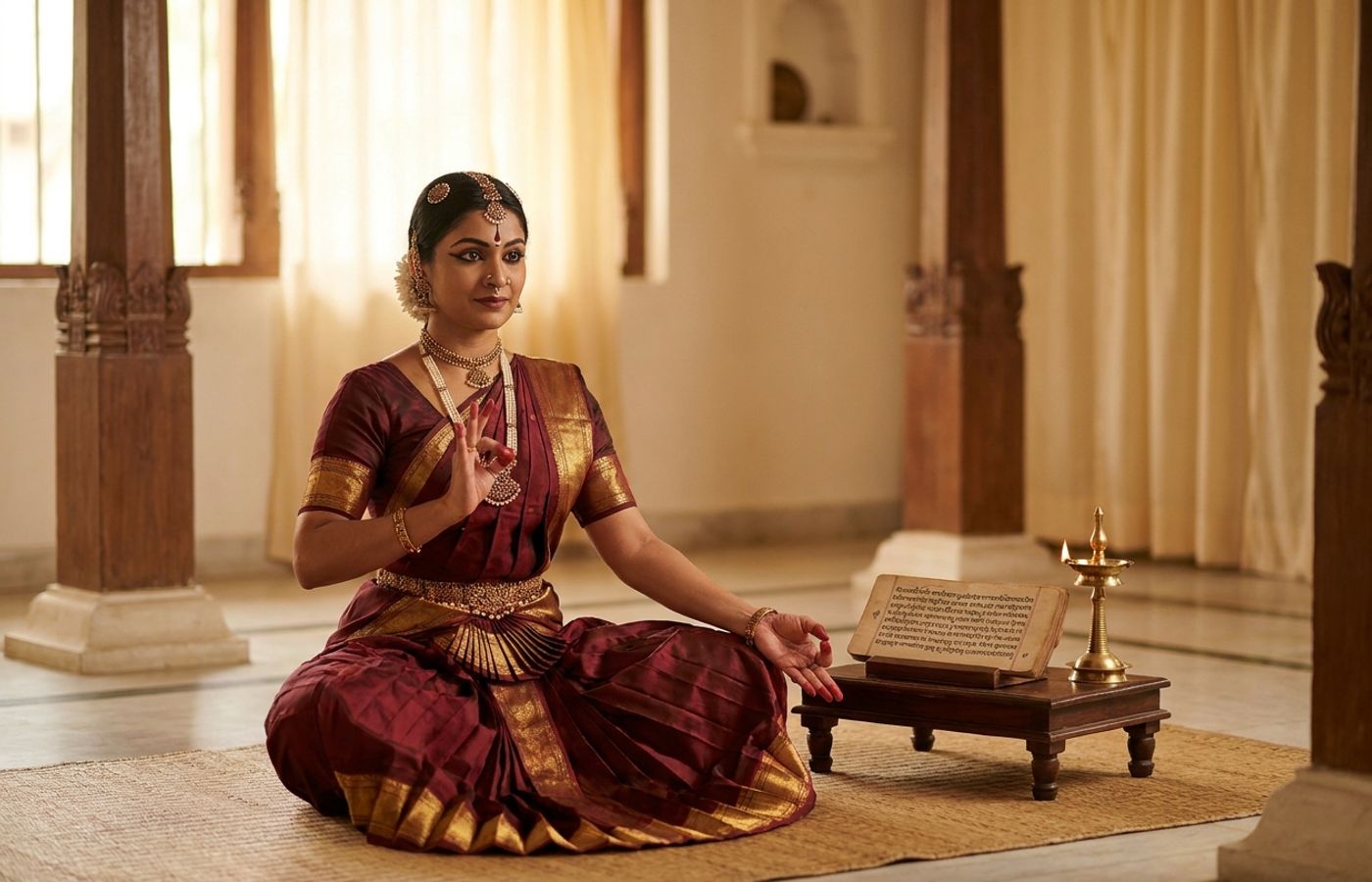
Every Bharatanatyam class you have ever attended is downstream of a single Sanskrit treatise. The Natya Shastra, attributed to the sage Bharata, is the oldest surviving text on Indian performing arts, and it is the reason a guru can name the precise movement of a neck, the precise direction of a glance, and the precise emotion a line of music is meant to carry. Most students meet it once, as a sentence in a history lesson, and then never open it again. It deserves better than that.
What follows is a plain explanation of what the text actually contains, which parts of it you are already practising without realising, and where the later manuals fit in. It is written for the students and parents at our studio in Lexington, Kentucky, and for the online students who join us from diaspora families in other cities, because understanding the source changes the way you practise. Once you know why a movement is named, you stop copying shapes and start reading them.
What the Natya Shastra Is, and Who Wrote It
The Natya Shastra is an encyclopedic Sanskrit work on natya, a word that covers drama, dance, and music together rather than any one of them alone. In its standard form it runs to thirty six chapters and several thousand verses. Authorship is traditionally given to Bharata, and the text addresses itself to his sons and pupils, which is why it is often called the Bharata Natya Shastra. Scholars generally treat it as a compilation that settled into its present shape somewhere between roughly 200 BCE and 200 CE, while recording a performance culture that was already mature by then.
It is important to understand the scope. The text discusses the construction and proportions of the playhouse, the preliminary rituals that open a performance, the classification of dramatic plots and characters, the use of language and metre, the tuning of instruments, the structure of tala, costume and makeup, and the theory of aesthetic experience. Dance is one strand inside a complete theory of theatre. Bharatanatyam did not exist as a named form when this text was composed. What Bharatanatyam inherited is the grammar, the vocabulary, and the aesthetic goal.
Natya as the Fifth Veda
The text opens with an origin story that is worth taking seriously rather than treating as decoration. The gods approach Brahma and ask for something that can be seen and heard, an object of knowledge accessible to everyone. Brahma composes the Natyaveda, drawing recitation from the Rigveda, song from the Samaveda, gesture from the Yajurveda, and rasa from the Atharvaveda. The new art is then given to Bharata to put into practice.
The claim embedded in that story is that performance is a form of knowledge, deliberately built to be open to all, without the restrictions attached to Vedic study. This is not a small point for a dance school. It is the reason a serious class is treated as study rather than recreation, and the reason guru-shishya parampara transmits meaning alongside movement. A student who can execute a jathi cleanly but cannot say what it is doing has learned only half of what was handed down.
The Four Abhinayas: How the Body Speaks
The text divides expression into four channels, and every syllabus in classical Indian dance still uses this division. Angika abhinaya is expression through the body, subdivided into anga or major limbs, pratyanga or secondary limbs, and upanga or minor parts such as the eyes, eyebrows, nose, lips, and chin. Vachika abhinaya is expression through speech and song. Aharya abhinaya is expression through costume, jewellery, and makeup. Sattvika abhinaya is the involuntary expression that arises from a genuine inner state, and it is the hardest of the four to teach.
In solo Bharatanatyam the vachika channel is carried by the vocalist and the nattuvanar, so the dancer's task is to interpret sung text rather than speak it. The bheda drills that students often treat as warm ups are upanga work drawn directly from this scheme. When we practise shiro bheda for the head, griva bheda for the neck, and drishti bheda for the eyes, we are training the smallest units of angika abhinaya so that they can later serve meaning instead of merely decorating it.
Bhava and Rasa: Why Abhinaya Is Not Acting
The most influential idea in the whole treatise is the relationship between bhava and rasa. Bhava is the emotional state that the performer presents and sustains. Rasa is the flavour that the spectator tastes as a result. The text is careful about the direction of that relationship. Rasa is produced in the audience; it is not something the dancer performs directly. The dancer's work is to assemble the conditions, the sung text, the situation, the gesture, the glance, and the stillness, so that rasa can arise in the person watching.
Bhavas are classified as well. Sthayi bhavas are the dominant, stable states that give a piece its emotional centre. Sanchari or vyabhichari bhavas are the transient states that pass across a face and body while the dominant state holds. Sattvika bhavas are the involuntary signs, such as trembling or a change in the voice, that cannot be faked convincingly. This is precisely why we tell students that abhinaya is not naturalistic acting. You are not pretending to feel something. You are constructing a state clearly enough that someone in the last row can receive it.
From Eight Rasas to Navarasa
Students are usually taught navarasa, the nine rasas, and are rarely told that the Natya Shastra itself enumerates eight. Those eight are shringara, the erotic or the romantic; hasya, the comic; karuna, the compassionate or sorrowful; raudra, the furious; vira, the heroic; bhayanaka, the fearful; bibhatsa, the odious; and adbhuta, the marvellous. Shanta, the peaceful, was argued into the canon by later aestheticians in the Kashmiri tradition of commentary, most famously associated with Abhinavagupta.
Knowing that the ninth rasa was a later addition is not trivia. It tells you that this is a living theoretical tradition rather than a frozen list, and it explains why shanta sits slightly apart from the others in practice. Shanta is not an emotional colour applied to a situation so much as the settling of emotion altogether, which is why it is difficult to portray and easy to confuse with a blank face.
Karanas, Hastas, and the Grammar Behind the Adavus
For pure movement, the text describes one hundred and eight karanas, which are units combining the position of the feet, the movement of the legs, and the carriage of the hands and torso, and thirty two angaharas, which are sequences built from them. It also catalogues hastas. The Natya Shastra lists twenty four single hand gestures and thirteen combined ones. The later and much shorter Abhinaya Darpana of Nandikeshvara, which most Bharatanatyam syllabi follow more closely, gives twenty eight asamyukta hastas and twenty four samyukta hastas.
The same pattern appears with the bhedas. The Natya Shastra describes thirteen movements of the head and nine of the neck, while the Abhinaya Darpana condenses the neck movements to the four that students in our intermediate batches learn by name. Be careful with one honest caveat here. The adavus themselves are not in the Natya Shastra. Adavus belong to the later Tanjore tradition that shaped the Bharatanatyam we practise, and the karanas do not map onto them one to one. What the treatise supplies is the analytical habit: name the part, name the movement, then combine.
Natya Dharmi and Loka Dharmi
The text also distinguishes two modes of presentation. Loka dharmi is the ordinary, lifelike mode, close to how people actually behave. Natya dharmi is the stylised, conventional mode, where a hasta stands for a deer, a river, or a lotus, and where a single glance can move a scene from one place to another. Bharatanatyam leans heavily on natya dharmi, and this is the concept that resolves the most common misunderstanding among newcomers. A dancer showing grief is not imitating a grieving person. She is using an agreed vocabulary that the audience has been trained by tradition to read.
How the Text Shows Up in Class
We do not ask beginners to read Sanskrit verses. We do insist on the vocabulary, because the vocabulary is the theory in portable form. A student who knows that the eyes belong to upanga, that a sustained mood is a sthayi bhava, and that rasa is completed by the viewer will practise differently from a student who only counts beats. Precision protects the body as well. Naming a movement exactly is how a guru corrects an aramandi that has drifted, or a neck movement that is being produced from the shoulders.
This is the same standard in our Lexington, Kentucky studio and in our online batches for diaspora families, where theory is often the part parents value most, because it gives their children a way to hold the culture rather than merely display it. Progress is measured over years, from the first adavus to alarippu and jathiswaram, and eventually to varnam and a full margam. The treatise is what keeps that long arc coherent.
If You Want to Read It Yourself
Read it slowly and selectively rather than front to back. The chapters on rasa and bhava are the natural entry point, followed by the chapters on the various abhinayas, where the treatment of the head, eyes, and hands begins to look familiar. Manomohan Ghosh's English translation is the one most commonly used by students in the West and is widely available. Pair it with the Abhinaya Darpana, which is far shorter, dance specific, and closer to what you are actually being taught. Avoid relying on short online summaries alone; they tend to flatten the theory into a list of nine emotions and lose everything that makes the text useful.
The reward for this effort is not academic. It is that your abhinaya stops being decoration and starts carrying meaning, and that your nritta acquires intent. If you want to see how this theory is taught in sequence, from the first stances to full margam repertoire, look through our curriculum or come and watch a class. Bring your questions about the text. They are the right questions to be asking.
Common questions
What is the Natya Shastra?
The Natya Shastra is an ancient Sanskrit treatise on the performing arts, attributed to the sage Bharata. In its standard form it runs to thirty six chapters and covers drama, dance, music, stagecraft, costume, and the theory of aesthetic experience. It is the oldest surviving text of its kind in the Indian tradition and the source of the vocabulary still used in Bharatanatyam today.
Who wrote the Natya Shastra, and when?
Authorship is traditionally attributed to Bharata, sometimes called Bharata Muni. Most scholars treat the text as a compilation that reached its present form somewhere between roughly 200 BCE and 200 CE, while recording performance practice that was already well established. Precise dating is debated, so treat any single confident date with caution.
Is the Natya Shastra only about Bharatanatyam?
No. Bharatanatyam did not exist as a named form when the text was composed. The Natya Shastra is a theory of natya, meaning theatre in the full sense of drama, dance, and music together. Bharatanatyam, along with the other classical Indian dance forms, inherits its analytical vocabulary, its scheme of abhinaya, and its theory of rasa.
What are the nine rasas, and are they all in the Natya Shastra?
The Natya Shastra itself lists eight rasas: shringara, hasya, karuna, raudra, vira, bhayanaka, bibhatsa, and adbhuta. Shanta, the peaceful, was added by later aestheticians, most famously in the commentarial tradition associated with Abhinavagupta, which gives the navarasa or nine rasas taught in dance classes today.
What is the difference between the Natya Shastra and the Abhinaya Darpana?
The Natya Shastra is the older, far larger treatise covering all of theatre. The Abhinaya Darpana of Nandikeshvara is a short, dance focused manual, and its counts are the ones most Bharatanatyam syllabi follow. For example, the Abhinaya Darpana gives twenty eight single hand hastas and four neck movements, while the Natya Shastra gives twenty four single hand hastas and nine neck movements.
Do beginners need to study the Natya Shastra to learn Bharatanatyam?
Beginners do not need to read the Sanskrit text, but they should learn the terminology that comes from it, because that vocabulary is the theory in usable form. In our beginner batches, students learn the names of the parts of the body, the four abhinayas, and the idea of bhava and rasa alongside their first adavus, so that technique and meaning develop together.