beginner
Manipuri Dance: One of India's Eight Classical Dance Forms
A guru's guide to Manipuri dance, its Raas Leela roots, gentle movement, and place among India's classical forms alongside Bharatanatyam.
When a family begins exploring classical Indian dance, they quickly discover that Bharatanatyam is one of several living traditions, each with its own grammar, music, and spirit. Manipuri dance is one of these forms, and understanding it helps students see where their own training sits within a much larger inheritance. Named for the northeastern state of Manipur, this gentle, devotional style is one of the eight classical dance forms recognized in India, and it offers a beautiful contrast to the geometric precision our students practice in the studio every week.
At Sridevi Dance Academy we teach Bharatanatyam, not Manipuri, but we believe a serious student should know the family of arts to which their form belongs. Learning what makes each tradition distinct sharpens a dancer's understanding of her own. This guide explains what Manipuri dance is, where it comes from, how it moves, and why its story matters to anyone studying classical dance, whether in person in Lexington, Kentucky or online across the diaspora.
What Is Manipuri Dance?
Manipuri dance is the classical dance tradition of Manipur, a state tucked into the hills of northeast India near the border with Myanmar. It is devotional at its core, growing out of the Vaishnavite faith that spread through the region and centering on the love of Radha and Krishna. Where some classical forms emphasize sharp lines and percussive footwork, Manipuri is known for softness. The dancer's body seems to float, moving in gentle curves and figure-of-eight patterns, the feet placed quietly so that no heel strikes the floor with force. The overall impression is one of grace, restraint, and inward devotion rather than outward display.
Like all classical Indian dance, Manipuri carries both a pure-movement dimension and a storytelling one. Its narrative themes are almost always drawn from the life and legends of Krishna. But the way it tells those stories is unmistakably its own, shaped by the music, costume, and temperament of Manipur itself.
Where Manipuri Sits Among India's Classical Dances
India recognizes eight classical dance forms, each rooted in a particular region and lineage. Bharatanatyam comes from Tamil Nadu in the south. Kathak developed in the north, Kathakali and Mohiniyattam in Kerala, Kuchipudi in Andhra Pradesh, Odissi in Odisha, Sattriya in Assam, and Manipuri in Manipur. These forms are not variations of a single dance. They are distinct grammars, with different footwork, hand gestures, music systems, and aesthetic goals, yet they share a common devotional origin in temple and court traditions.
Placing Bharatanatyam beside Manipuri makes each one clearer. Bharatanatyam is built on the aramandi, the deep half-sitting posture, and on crisp, rhythmic footwork that answers the syllables of the drum. Manipuri asks the body to stay soft and continuous, hiding effort rather than displaying it. Both are demanding. Both take years to learn. They simply pursue beauty by different paths, and a student who understands this contrast tends to dance her own form with more intention.
The Raas Leela and Its Devotional Heart
The most celebrated expression of Manipuri dance is the Raas Leela, a dance drama depicting the divine play of Krishna with Radha and the gopis, the cowherd women of Vrindavan. Traditionally performed on moonlit nights during festivals, the Raas is not entertainment in the ordinary sense. It is an act of worship, a way of entering the story of divine love and offering it back to the community and the deity. Dancers move in circular formations around Krishna, their veiled faces lowered, the whole scene glowing with a quiet, sacred intensity.
This devotional purpose is something Bharatanatyam students recognize instantly. Our own repertoire, from alarippu to varnam, carries the same understanding that classical dance began as an offering. The costumes, the drums, and the vocabulary differ, but the reverence is shared. That shared root is one reason the eight forms are spoken of as a family.
How Manipuri Movement Differs From Bharatanatyam
The clearest difference is in the feet and the face. In Bharatanatyam, footwork is percussive and audible. The dancer strikes the floor in precise rhythm, ankle bells ringing, and the face carries strong, legible abhinaya that projects emotion to the back of the hall. In Manipuri, the feet touch the ground softly, almost silently, and facial expression is deliberately restrained. Emotion is suggested through the flow of the whole body rather than declared through the eyes and brows.
Manipuri also carries two contrasting energies within it. The lasya aspect is gentle, lyrical, and graceful, seen in the women's Raas dances. The tandava aspect is vigorous and masculine, seen in the drum and cymbal dances performed by men. Bharatanatyam holds a similar balance between nritta, the pure rhythmic movement, and nritya, the expressive storytelling, though it organizes that balance in its own way. Noticing these parallels helps a young dancer see the deeper logic that runs through all classical Indian dance.
Costume, Music, and the Pung
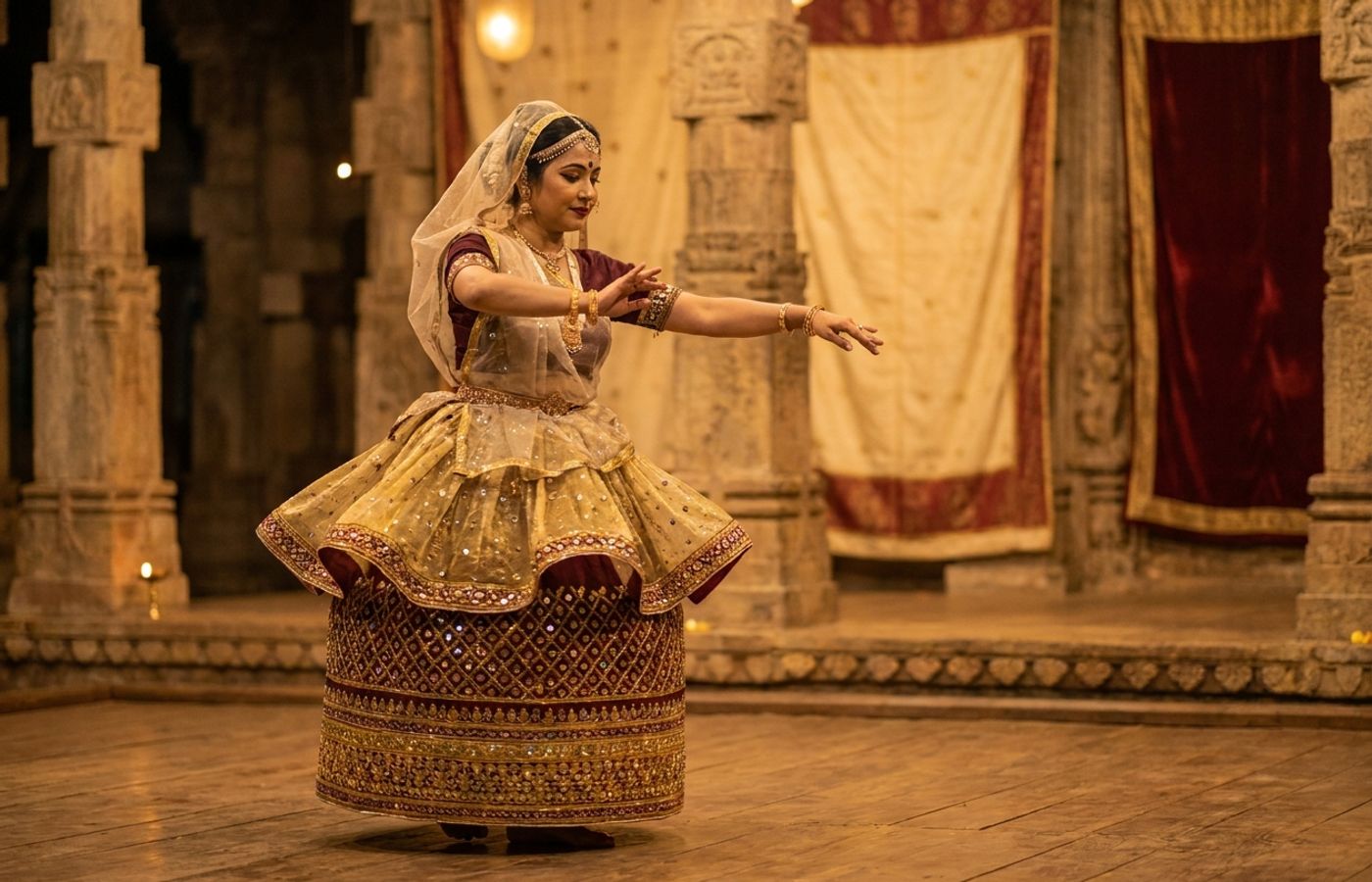
Nothing announces Manipuri dance more instantly than its costume. The female Raas dancer wears the kumil, a stiff, barrel-shaped skirt richly embroidered and decorated with mirror work and gold, topped by a translucent veil that softens the face. It is one of the most recognizable costumes in all of Indian dance, and it shapes the movement itself, encouraging the smooth, gliding steps the form is known for. This is very different from the fitted, pleated Bharatanatyam costume that reveals the sharp lines of the aramandi and the legs.
The music is equally distinctive. Manipuri dance is accompanied by the pung, a barrel-shaped drum sometimes called the Manipuri mridang, along with cymbals and devotional singing in the local tradition. The related Sankirtana performing art of Manipur, with its drumming and singing, is honored internationally as a treasure of intangible cultural heritage. For Bharatanatyam families, whose art is set to Carnatic music and the nattuvangam of the guru's cymbals, hearing the pung is a reminder of how varied India's musical landscape truly is.
Why Sister Forms Matter for Bharatanatyam Students
Studying a form like Manipuri does not distract from Bharatanatyam training. It deepens it. When a student understands that her percussive footwork is a deliberate choice, made vivid by the existence of a form that chooses silence instead, she begins to dance with awareness rather than habit. She learns to see abhinaya, rhythm, and posture as decisions that carry meaning, not simply as steps to be copied. This is the difference between performing the form and understanding it, and it is the standard we hold our students to.
It also gives young dancers in the diaspora a fuller picture of their heritage. A child growing up far from India may assume that classical dance means only the style she happens to study. Knowing that Manipuri, Odissi, Kathak, and the rest exist, each guarding its own centuries of practice, turns a single class into a doorway onto an entire civilization of art. That perspective tends to make students prouder of, and more committed to, the discipline they have chosen.
Learning Classical Dance in Lexington and Online
Sridevi Dance Academy specializes in Bharatanatyam, taught in the guru-shishya parampara, the traditional relationship between teacher and student that has carried these arts forward for generations. We train students in Lexington, Kentucky and online for diaspora families across the country, moving carefully from the first adavus through abhinaya and eventually the full margam. Along the way we teach not only the steps but the meaning behind them, so that every dancer understands the tradition she is part of, including how it stands among sister forms like Manipuri.
If your family is drawn to the beauty of classical Indian dance and wants serious, structured, culturally grounded training, Bharatanatyam is a wonderful place to begin. We would be glad to help your child, or you as an adult returning to your roots, take that first step with a guru who treats every hasta and bhava as something to be measured, named, and understood.
Common questions
What is Manipuri dance?
Manipuri dance is the classical dance tradition of Manipur in northeast India. It is devotional in nature, centered on the love of Radha and Krishna, and known for gentle, flowing movement, soft footwork, and restrained facial expression rather than the percussive style of some other forms.
Is Manipuri one of the classical dance forms of India?
Yes. India recognizes eight classical dance forms: Bharatanatyam, Kathak, Kathakali, Kuchipudi, Odissi, Mohiniyattam, Sattriya, and Manipuri. Each belongs to a specific region and lineage and shares a common devotional origin in temple and court traditions.
How is Manipuri dance different from Bharatanatyam?
Bharatanatyam is built on the deep aramandi posture with crisp, audible footwork and strong facial abhinaya. Manipuri keeps the body soft and continuous, places the feet quietly with no forceful heel strikes, and expresses emotion through the flow of the whole body rather than the face.
What is the Raas Leela in Manipuri dance?
The Raas Leela is the most celebrated Manipuri dance drama, depicting the divine play of Krishna with Radha and the gopis of Vrindavan. Traditionally performed on moonlit festival nights, it is an act of worship rather than mere entertainment, with dancers moving in circular formations around Krishna.
What costume do Manipuri dancers wear?
The female Raas dancer wears the kumil, a stiff, barrel-shaped, richly embroidered skirt decorated with mirror work and gold, topped by a translucent veil over the face. This distinctive costume shapes the smooth, gliding movement that Manipuri dance is known for.
Can my child learn Bharatanatyam if we love classical Indian dance in general?
Absolutely. Sridevi Dance Academy teaches Bharatanatyam in the traditional guru-shishya parampara, in person in Lexington, Kentucky and online for diaspora families. We introduce students to the wider family of classical forms while giving them serious, structured training in Bharatanatyam itself. You can schedule a trial class to begin.