intermediate
Indian Tala Explained: Rhythm for Bharatanatyam Students
Indian tala explained for Bharatanatyam students: angas, the seven suladi talas, Adi tala, sollukattu, nattuvangam and laya, taught as a guru teaches it.
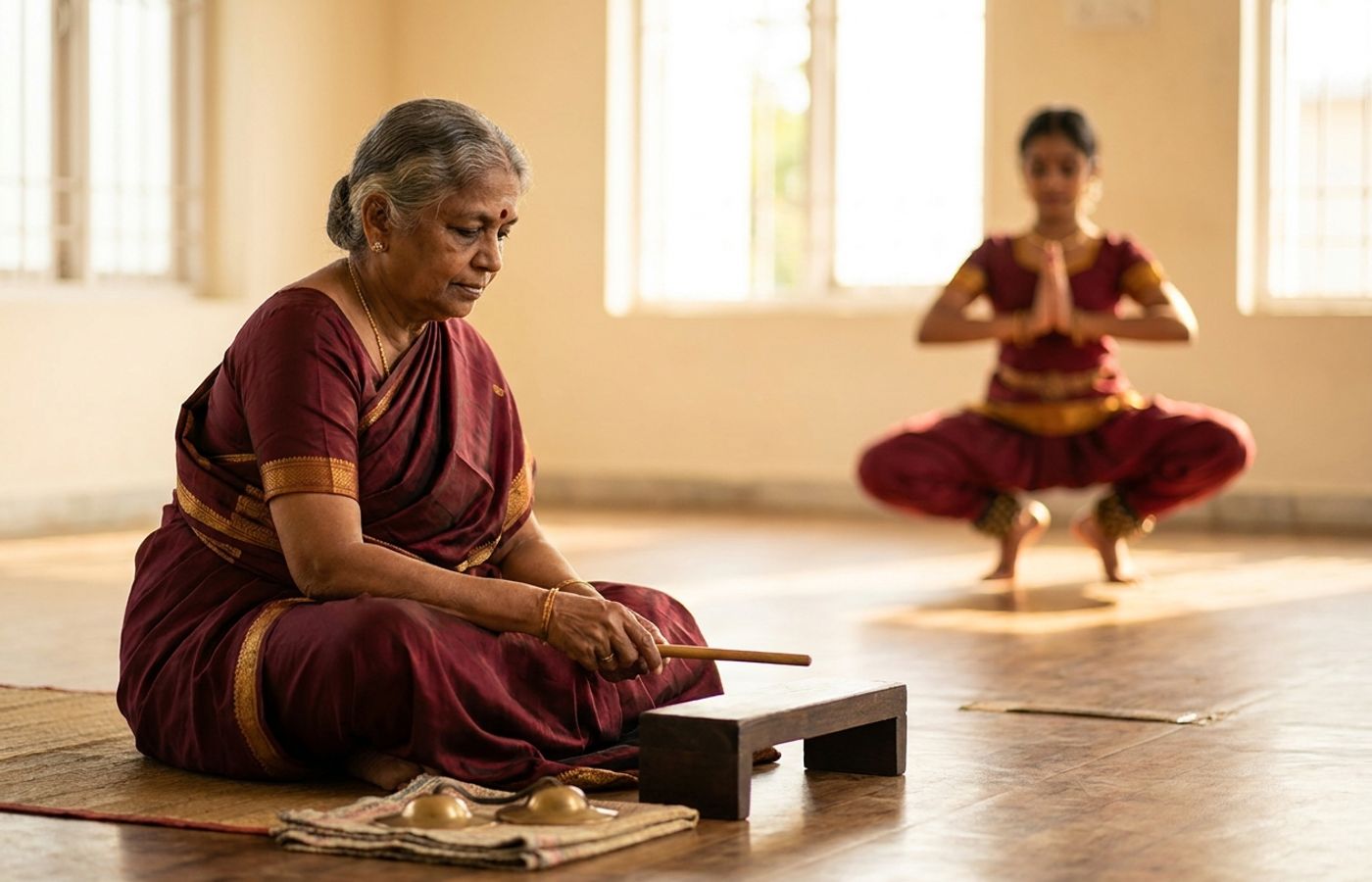
Every Bharatanatyam class begins with a sound before it begins with a step. The guru strikes the thattukazhi against the wooden block, counts aloud, and the room settles into a shared pulse. That pulse is tala. If you have searched for Indian tala and found pages explaining time cycles in Carnatic or Hindustani music, you have met only half the subject. For a dancer, tala is not something to listen to. It is something to stand inside, hold with the feet, and answer with the whole body.
What Indian tala means in Bharatanatyam
Tala comes from the Sanskrit for a clap, the tapping of the hand on the arm. In practice it is a fixed cycle of beats, called aksharas, that repeats unchanged through a composition. A raga gives a piece its melodic identity. The tala gives it its architecture. Musicians count the cycle with their hands. A dancer counts it with her entire body, because the adavu, the hasta and the drishti all have to arrive on the beat the tala has assigned them.
The Indian tala system used in Bharatanatyam is the Carnatic system of South India. That distinction matters, because most general writing about tala leans on Hindustani terms such as theka and matra. A Bharatanatyam student needs the Carnatic vocabulary instead: angas, jaatis, aksharas and the seven suladi talas. These are the words your nattuvanar will use in class, and the ones written into the compositions you will eventually dance.
The three angas that build every tala
A tala is assembled from small rhythmic units called angas. Carnatic practice uses three of them. Laghu is a clap followed by counts on the fingers, and its length is not fixed, which is what makes the whole system flexible. Drutam is a clap followed by a wave of the hand, always two beats. Anudrutam is a single clap, always one beat.
Learn to show these three with your hands before you attempt to dance them. Students in our beginner batches sit and clap the cycle for several weeks before it is ever attached to footwork. It looks slow from the outside. It is the reason their adavus stay clean later, when the speed rises and there is no time left to think.
Seven talas, five jaatis, thirty five combinations
The suladi sapta talas are the seven parent talas: Dhruva, Matya, Rupaka, Jhampa, Triputa, Ata and Eka. Each is a fixed arrangement of angas. Rupaka is one drutam followed by one laghu. Eka is a single laghu and nothing more. Triputa is a laghu followed by two drutams.
The length of the laghu is set by the jaati, and there are five: Tisra of three beats, Chatusra of four, Khanda of five, Misra of seven and Sankeerna of nine. Seven parent talas multiplied by five jaatis gives the thirty five talas of the Carnatic system. A student does not need all thirty five. She needs to understand that the system is generative rather than arbitrary, and she needs a handful of them genuinely in her body.
Adi tala, the dancer's home ground
Adi tala is Chatusra jaati Triputa tala: a laghu of four beats, then two drutams of two beats each, eight aksharas in all. It is the cycle most adavus are first taught in, and the one most students will dance in for the rest of their lives.
Tatta adavu, the first adavu a beginner meets, is usually taught as a set of eight variations struck into this eight beat frame. The count is even, the divisions are clean, and a new student can feel the cycle close and reopen under her feet. Once Adi tala is genuinely reliable, Rupaka and Misra Chapu stop feeling foreign, because by then the student is no longer counting. She is listening.
Gati, also called nadai, is the subdivision inside each beat. The same Adi tala can be filled with four subdivisions per beat or with three, and the footwork changes character completely while the cycle itself never moves. This is where most students first discover that tala is a container rather than a metronome.
Sollukattu: how the tala reaches the feet
Bharatanatyam does not ask a dancer to count in silence. It gives her syllables. Sollukattu, also written solkattu, are spoken rhythmic syllables such as tai ya tai hi or tha thai thai tha, and every adavu carries its own. The syllables are not decoration. They encode the rhythm, which is why a student who can say an adavu correctly can almost always dance it correctly.
A jathi is a longer composed passage of these syllables, danced as pure nritta. Jathis are set into the tala with a defined starting point called eduppu, which may fall on the first beat of the cycle or deliberately before or after it. Learning to enter away from the sama, away from beat one, is one of the harder thresholds in intermediate training, and it is entirely a question of tala rather than of technique.
Most jathis close with a teermanam or korvai, a cadence phrase stated three times so that the final syllable lands exactly on the first beat of the returning cycle. When a rhythmic passage feels deeply satisfying to an audience that cannot explain why, this symmetry is usually the reason.
Nattuvangam and the guru's cymbals
Nattuvangam is the art of conducting the dance. The nattuvanar holds the talam, a pair of small cymbals, keeps the tala and recites the sollukattu that the dancer answers with her feet. In the classroom the same role is played with the thattukazhi struck against the thattupalagai, the wooden block every student learns to trust.
This is why tala in Bharatanatyam is inseparable from guru-shishya parampara. The rhythm is not delivered by a recording. It is held by a person who can slow the cycle for a struggling student, sharpen a late entry in the moment it happens, or push the tempo when a dancer is finally ready for it. Recorded tracks are useful for home practice. They cannot teach eduppu, and they certainly cannot correct it.
Laya: the three speeds a dancer must hold
Laya is tempo, the speed at which the tala moves. Classical practice recognises three: vilambita or slow, madhya or medium, and drutha or fast. Adavus are learned in all three, and each makes a different demand.
Slow speed is the honest test. There is nowhere to hide a shallow aramandi or a late hasta when every beat is long. Fast speed tests stamina and recovery, and exposes any step that was only ever half learned. Medium speed is where most performance actually lives. A dancer trained at a single speed will lose the tala the moment the nattuvanar changes it, which on stage he certainly will.
How tala shapes the margam
The margam, the traditional concert sequence, is arranged so that a dancer's relationship with tala deepens item by item. Alarippu, the opening item, is set to sollukattu and tala with no melodic composition to lean on, so the student has nothing but rhythm and her own body. Jathiswaram builds pure nritta on musical swaras and jathis, adding melody to the rhythmic frame without yet adding story.
Varnam, the centrepiece, alternates dense rhythmic passages with sustained abhinaya, and the dancer must hold the tala internally through long expressive sections where the footwork has stopped entirely. Tillana, near the close, returns to rhythm at speed and asks for precision when the body is already tired. A student preparing for arangetram is not only learning choreography. She is being tested on whether tala has become internal.
Where students usually lose the tala
After enough years in the classroom the same handful of errors appear again and again. Students rush the beats immediately before a teermanam, hurrying toward the resolution instead of letting the cycle carry them to it. They breathe out of time, which slowly drags the tempo. They count in their heads rather than aloud, so small drifts go unnoticed until a performance exposes them. They practise the sections they enjoy, which are rarely the sections where their timing is weakest.
None of these are talent problems. Every one of them is corrected by returning to slow speed with the sollukattu spoken out loud, which is exactly what a guru will ask for, and exactly what most students resist.
Building reliable tala at home
Tala improves through short daily contact rather than long weekend sessions. These are the habits we ask of students who train with us in Lexington, Kentucky, and of the online batches we teach for diaspora families elsewhere in the United States and abroad.
Clap the cycle before you dance it. Sit, show the angas with your hands, and say the sollukattu aloud until it is even. Recite before you move, because if you cannot speak a jathi cleanly at medium speed your feet will not rescue it. Practise one adavu in all three speeds rather than three adavus in one. Count aloud rather than silently. Record yourself, find the place where you rush, and work only that place for a week.
Where to begin
Tala is the part of Bharatanatyam that students most often try to move past quickly and most often return to years later. It cannot be absorbed from video alone. It is taught by a guru who keeps the cycle alive in the room, corrects an entry the instant it slips, and holds a student at slow speed considerably longer than she would like.
If you are beginning, or returning to the art as an adult, the honest starting point is one tala held properly rather than a repertoire held loosely. Everything else in the form, from the first tatta adavu to the varnam of an arangetram, is built on that single skill.
Common questions
What is tala in Bharatanatyam?
Tala is the fixed rhythmic cycle that a composition repeats without change. It is measured in beats called aksharas and built from three units called angas: laghu, drutam and anudrutam. In Bharatanatyam the dancer does not simply follow the tala, she carries it in her footwork while the nattuvanar keeps it with cymbals and spoken syllables.
What is Adi tala and why is it taught first?
Adi tala is Chatusra jaati Triputa tala, an eight beat cycle made of a four beat laghu and two drutams of two beats each. It is taught first because its divisions are even and easy to feel, which lets a beginner sense the cycle closing and reopening. Most basic adavus, including tatta adavu, are introduced within it.
How many talas are there in the Carnatic system?
There are seven parent talas, the suladi sapta talas: Dhruva, Matya, Rupaka, Jhampa, Triputa, Ata and Eka. Each can be set in one of five jaatis, which fix the length of the laghu at three, four, five, seven or nine beats. Seven talas across five jaatis produce thirty five talas in total, though a dancer works closely with only a few of them.
What is the difference between tala and laya?
Tala is the structure of the cycle, meaning how many beats it holds and how they are grouped. Laya is the speed at which that cycle moves. The same Adi tala can be danced slow, medium or fast without its structure changing at all. Students are trained in all three speeds because each one exposes a different weakness.
Do I need to learn Carnatic music to understand tala?
No. A dancer learns tala through the body rather than through musical theory. You will learn to show the angas with your hands, speak the sollukattu for each adavu, and recognise the cycle by feel. Familiarity with Carnatic music deepens that understanding over time, but it is never a prerequisite for starting Bharatanatyam.
Can tala be learned in an online Bharatanatyam class?
Yes, provided the class is live and taught by a guru rather than delivered as recorded video. A teacher keeping tala in real time can slow the cycle, correct a late eduppu and adjust the speed to the student in front of her. Our online batches run this way for diaspora families, alongside the in-person classes we teach in Lexington, Kentucky.