beginner
Bharatanatyam: The Traditional Dance of India Explained
Bharatanatyam is India's best known traditional dance, rooted in the temples of Tamil Nadu. Discover its origins, grammar, and how students learn it today.
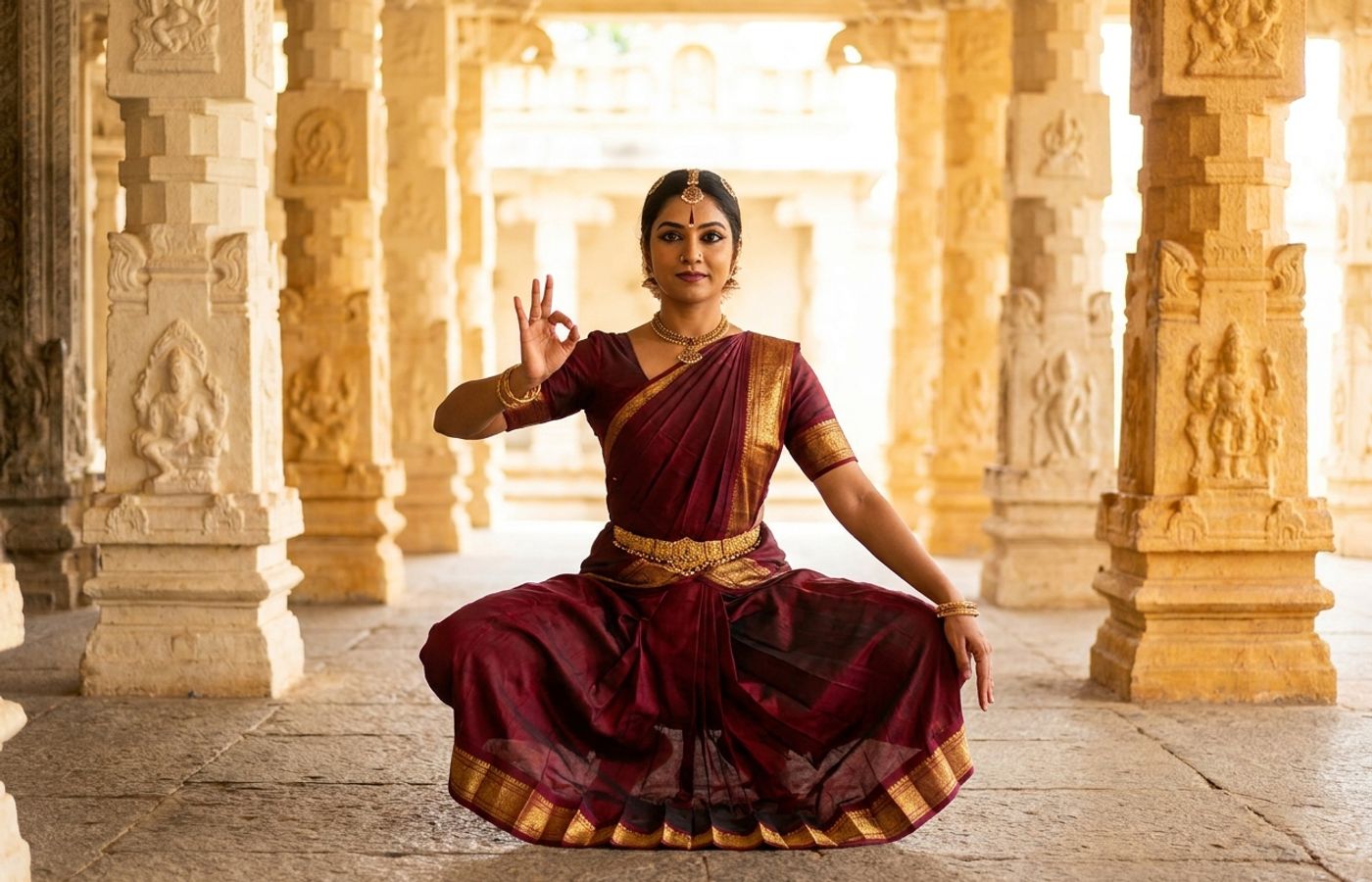
Ask someone to name the traditional dance of India and the answer often points south, to the temple towns of Tamil Nadu where Bharatanatyam took shape over many centuries. It is one of the oldest and most complete classical dance traditions in the country, a form in which rhythm, storytelling, music, and devotion are woven into a single discipline. For diaspora families who want their children to understand where they come from, and for adults returning to their roots, Bharatanatyam offers something rare: a living art that is both physically demanding and deeply meaningful. This guide explains what the form is, where it comes from, and how it is learned today, both in person in Lexington, Kentucky and online across the diaspora.
What Makes Bharatanatyam the Traditional Dance of India
India does not have only one traditional dance. It has many, and they fall into two broad families. Folk dances grow out of village life, harvest, and festival, and they change from region to region and community to community. Classical dances follow a codified grammar drawn from the Natyashastra, an ancient Sanskrit treatise on drama, music, and dance attributed to the sage Bharata. A style earns classical status by adhering to that grammar, by carrying a continuous teaching lineage, and by treating dance as a complete performing art rather than casual entertainment.
India is generally recognized as having eight classical dance traditions: Bharatanatyam from Tamil Nadu, Kathak from the north, Kathakali and Mohiniyattam from Kerala, Kuchipudi from Andhra Pradesh and Telangana, Odissi from Odisha, Manipuri from Manipur, and Sattriya from Assam. Each carries the culture and stories of its region, and most draw their themes from Hindu mythology. Among all of them, Bharatanatyam is the one many people picture first when they think of the traditional dance of India, in part because of its antiquity and its precise, sculptural lines that echo the poses carved into South Indian temples.
Temple Origins in Tamil Nadu
Bharatanatyam grew inside the temples of Tamil Nadu, where dance was an offering to the deity rather than a show for an audience. For generations it was preserved and performed within temple and court settings, passed from teacher to student through the discipline known as guru-shishya parampara, the lineage that binds a guru to a shishya. In that older setting the form was often called Sadir or Dasi Attam, and its repertoire, music, and grammar were carried forward by dedicated families of teachers and musicians.
In the early twentieth century the art moved onto the concert stage and into the public eye, and it came to be known widely as Bharatanatyam. Figures associated with this revival, including E. Krishna Iyer and Rukmini Devi Arundale, helped renew respect for the form and open it to a new generation of students. What survived that transition is remarkable: the same postures, hand gestures, and expressive language that shaped the temple tradition still anchor the way Bharatanatyam is taught today.
Nritta, Nritya, and Natya: The Three Threads
To understand Bharatanatyam it helps to know that the form braids together three strands. Nritta is pure movement: rhythmic footwork and clean lines performed for the beauty of the pattern itself, with no story attached. Nritya adds meaning, using the face and hands to convey a mood, a character, or a line of song. Natya is the dramatic dimension, the theatrical storytelling that turns the dancer into a narrator of myth and emotion.
The art that carries meaning is called abhinaya, the craft of expression. A trained dancer uses bhava, or emotion, to awaken rasa, the aesthetic flavor an audience tastes in a performance. This is why serious study of Bharatanatyam is never only about the steps. A student learns the theory and meaning behind each movement so that a raised hand or a turn of the eyes says exactly what the music and poetry intend.
The Building Blocks: Aramandi, Adavus, and Hastas
Every Bharatanatyam student begins with the same foundations. The signature posture is the aramandi, a grounded half-sitting stance with the knees turned out, which gives the dance its stable, rooted quality. From that base come the adavus, the basic units of the form that combine footwork, posture, and hand positions into repeatable patterns. Adavus are the alphabet of Bharatanatyam, and years of practice make them second nature.
The hands carry much of the language. Hastas, also called mudras, are codified gestures divided into asamyukta hastas performed with a single hand and samyukta hastas performed with both hands together. A single gesture can stand for a lamp, a river, a bird, or a god depending on context. Layered over all of this are tala, the rhythmic cycle, and raga, the melodic framework, so that the dancer is always moving in precise conversation with the music.
The Margam: How a Full Recital Unfolds
A traditional Bharatanatyam recital follows a structure called the margam, a word that means the path. The sequence was systematized in the nineteenth century by the Thanjavur Quartet, four brothers whose ordering of items still shapes recitals today. A margam typically opens with the alarippu, a pure invocation of rhythm, moves through the jathiswaram and shabdam, and rises to the varnam, the long and demanding centerpiece that blends pure dance with sustained expression. It then softens into padams and javalis rich in emotion before closing with the bright, celebratory tillana.
When a student is ready to present a full margam alone on stage, that debut is called the arangetram. It is not a graduation so much as a milestone, a public sign that the dancer can carry the tradition with control and understanding. Reaching it takes patient, guided work, and no honest teacher promises a shortcut.
Why This Tradition Still Matters
For a child growing up far from India, Bharatanatyam is a way to hold on to language, story, and heritage through the body itself. For an adult, it is a return to a discipline that rewards patience and attention. In every case the form teaches more than choreography. It builds posture, stamina, and focus, and it connects the student to a lineage that stretches back through temples and gurus for generations. Taught well, with safe and gradual progression, it is as good for the mind and spirit as it is for the body.
There is also a quieter benefit that parents often notice over time. Because Bharatanatyam names and explains everything, from the angle of the knees in aramandi to the meaning of a single mudra, a student learns to observe carefully, to correct patiently, and to hold high standards for their own work. That habit of precise, measured practice carries well beyond the dance floor. A guru who understands both the art and the body can guide progress without strain, so that a young dancer grows in strength and confidence season after season rather than chasing a shortcut that never lasts.
Learning Bharatanatyam Today, in Lexington and Online
At Sridevi Dance Academy the tradition is passed on the way it always has been: one guru, one lineage, with theory taught alongside technique. Students move through a structured, multi-year curriculum that begins with aramandi and adavus, builds toward the varnam, and prepares committed dancers for a full margam and arangetram. Classes are small, disciplined, and warm, and every step, hasta, and bhava is measured, named, and understood rather than merely copied. Whether you are in Lexington, Kentucky or joining online from elsewhere in the diaspora, the path into India's traditional dance begins with a single honest class. Families who are curious are welcome to schedule a trial and see the work up close.
Common questions
What is the traditional dance of India?
India has several traditional dances, generally recognized as eight classical forms: Bharatanatyam, Kathak, Kathakali, Kuchipudi, Odissi, Manipuri, Mohiniyattam, and Sattriya. Bharatanatyam, from Tamil Nadu, is the one most people picture first because of its antiquity and its precise, temple-rooted style.
How old is Bharatanatyam?
Its grammar traces back to the Natyashastra, an ancient Sanskrit treatise on the performing arts. The form was preserved for generations in the temples and courts of Tamil Nadu, and the recital structure used today was systematized in the nineteenth century, before the art moved onto the modern concert stage in the twentieth century.
What is the difference between classical and folk dance in India?
Folk dances arise from village and community life and vary widely by region. Classical dances follow a codified grammar drawn from the Natyashastra, carry a continuous teaching lineage, and treat dance as a complete performing art with its own theory of rhythm, melody, and expression.
Can adults learn Bharatanatyam, or is it only for children?
Adults can absolutely learn Bharatanatyam. Many adult beginners return to the art to reconnect with their roots. The training is adapted to the student's stage of life, with careful attention to posture and safe, gradual progression rather than rushing the body.
How long does it take to learn Bharatanatyam?
It is a multi-year path. Students spend a long time mastering aramandi, adavus, and hastas before progressing to expressive items and eventually a full margam. Committed dancers may work toward an arangetram after several years of guided study. The pace depends on the student, and no serious teacher guarantees quick results.
Can I learn Bharatanatyam online?
Yes. Sridevi Dance Academy teaches students in person in Lexington, Kentucky and online for diaspora families elsewhere. Online study follows the same structured, guru-led curriculum, with the teacher watching posture and technique closely over video.