beginner
Bharatanatyam Styles: A Guru's Guide to the Major Banis
Bharatanatyam styles, called banis, are living lineages rather than brands. A guru explains Thanjavur, Pandanallur, Vazhuvoor, Kalakshetra and Melattur.
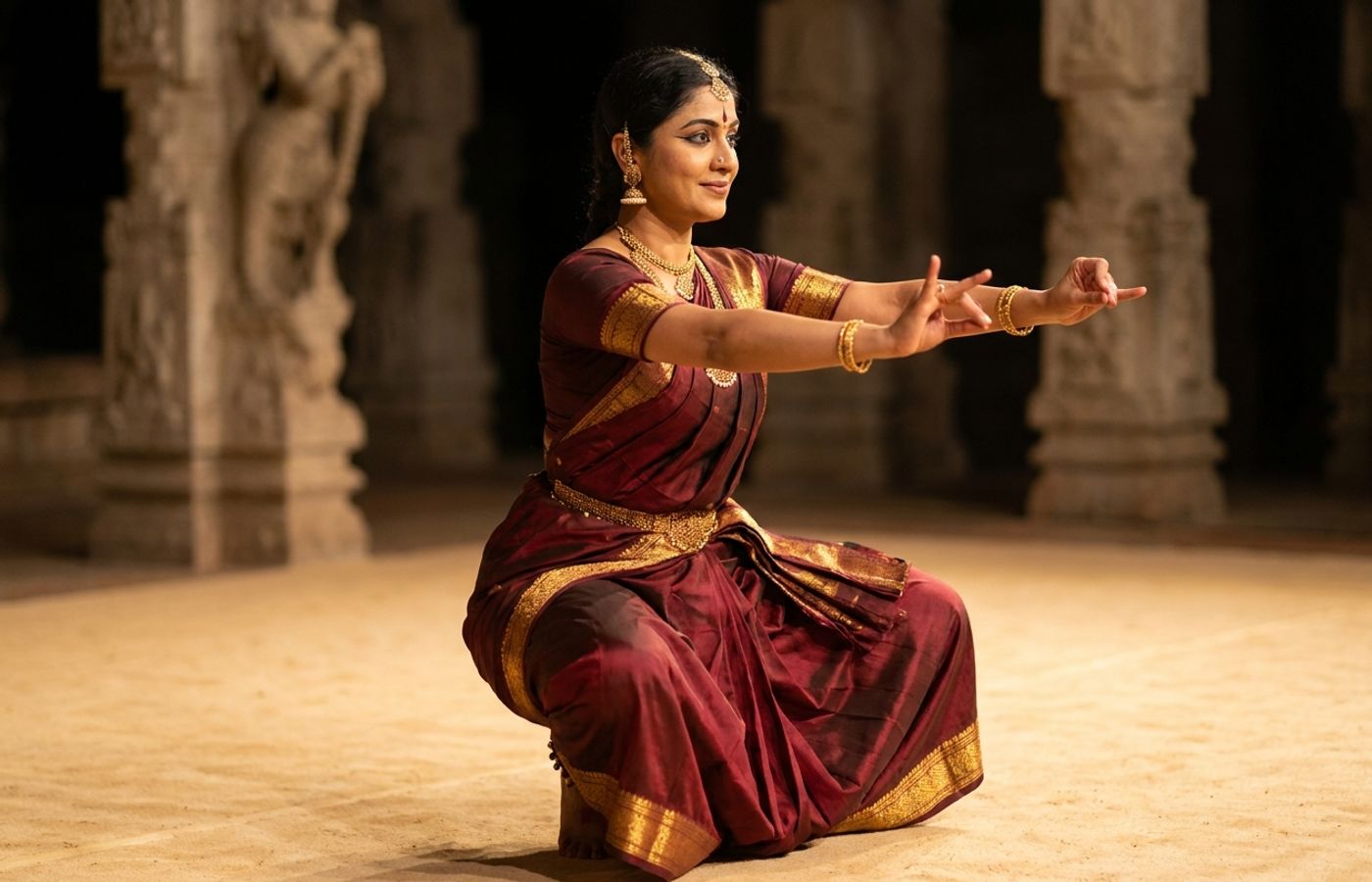
Families who search for Bharatanatyam styles usually expect a menu. Pick one, sign up, done. The reality is quieter and far more interesting. What the internet calls styles are called banis inside the tradition, and a bani is not a product line. It is a lineage: a particular way of holding the body, shaping a line and treating a song, received by a guru from her guru and handed on to the next shishya. At Sridevi Dance Academy in Lexington, Kentucky, and in our online classes for diaspora families across the country, this is one of the first serious questions parents ask. It deserves a serious answer rather than a list.
What Bharatanatyam styles actually are: the meaning of bani
Bani means manner or style, and in dance it refers to the distinctive approach of one teaching lineage. Most banis carry the name of the town or village where the teaching family lived and taught. Thanjavur, Pandanallur, Vazhuvoor and Melattur are places on a map of Tamil Nadu before they are labels on a class brochure. Kalakshetra is the exception, named for the institution where its approach took shape. These names are addresses of lineages, not trademarks, and no lineage owns the art.
This matters because the differences between banis are differences of emphasis and proportion, not of grammar. Every bani teaches aramandi, the half sitting stance that gives the form its architecture. Every bani teaches adavus, hastas, the bhedas of the head, neck and eyes, and the distinction between nritta, nritya and natya. Every bani works from the same textual inheritance, principally the Natya Shastra and the Abhinaya Darpana, and dances to Carnatic music guided by nattuvangam. A trained eye sees the family resemblance long before it sees the differences.
The Thanjavur bani and the birth of the margam
In the early nineteenth century, four brothers who served the Maratha court at Thanjavur under King Serfoji II gave the solo repertoire the shape it still holds. Chinnayya, Ponnayya, Sivanandam and Vadivelu, known together as the Thanjavur Quartet, arranged the concert sequence that dancers call the margam: alarippu, jathiswaram, shabdam, varnam, padam and tillana. They also composed a large body of music for that sequence.
The Thanjavur approach is marked by architectural clarity. The dance sits squarely inside the tala, ornament is admitted only when it serves the structure, and the line of the body is expected to be legible from the back of the hall. Every bani discussed below either descends from this work or is in conversation with it. When a student learns her first alarippu, she is standing inside a two hundred year old decision about how a recital should open.
Pandanallur: geometry, restraint and a deep aramandi
The Pandanallur bani takes its name from the village associated with Meenakshisundaram Pillai, who carried the Thanjavur inheritance forward and taught many of the twentieth century's most visible dancers. The lineage continued through Chokkalingam Pillai and Subbaraya Pillai.
Its signature is geometry. The aramandi is wide and low, the arms travel in straight lines and settle at unambiguous angles, and transitions are clean rather than decorative. Nritta is unhurried and exact. Abhinaya tends toward restraint, trusting the poetry and the music to carry feeling rather than amplifying it with the face and torso. For a beginner this is demanding work. It asks for strength in the thighs, patience with repetition and a willingness to be corrected on a single degree of angle. It also builds a body that can be trusted on stage.
Vazhuvoor: lasya, curve and sculptural line
The Vazhuvoor bani is associated with Vazhuvoor Ramaiah Pillai. Where Pandanallur draws with a ruler, Vazhuvoor draws with a curve. Transitions are rounded, the torso participates more openly, and poses often resolve into shapes that recall temple sculpture. The lasya quality, the graceful and lyrical aspect of the form, is given more room, and abhinaya is expansive and theatrical in the best sense.
This bani reached a very wide audience in the twentieth century, partly through dancers such as Kamala Lakshman, who performed widely and on screen. Families sometimes describe it as the softer style. That is a shortcut worth resisting. Fluidity is not the absence of discipline. Holding a sculptural pose in aramandi while the face carries a full sanchari is at least as difficult as holding a straight line.
Kalakshetra: precision, ensemble and the modern stage
Rukmini Devi Arundale founded Kalakshetra in Madras, now Chennai, in 1936, and the approach developed there became a bani in its own right. It is known for angular precision, crisp and highly codified adavus, and a restrained presentation on stage. Kalakshetra also developed the Bharatanatyam dance drama, staging episodes from the Ramayana and other sources with groups of dancers rather than a single soloist.
Because it was designed to be taught in an institution to many students at once, this approach travels well and is widely encountered outside India. Its ensemble work is a genuine contribution: it gives students experience of dancing in relation to others, holding formation and matching timing, which solo training alone does not provide.
Melattur: abhinaya, sanchari and interior devotion
Melattur is a village in Tamil Nadu long associated with the Bhagavata Mela dance drama tradition, and the Bharatanatyam bani that carries its name is linked to Mangudi Dorairaja Iyer. Its emphasis falls on abhinaya and on sanchari bhava, the elaboration of a single line of poetry into many imagined situations. Improvisation within a fixed structure is valued, and the orientation is devotional and inward rather than display oriented. It is the bani most often described as a spiritual practice first and a performance practice second.
A common confusion: margam items are not styles
Search results frequently list alarippu, jathiswaram, shabdam, varnam, padam and tillana as the styles of Bharatanatyam. They are not. Those are items in the margam, the ordered sequence of a full recital, and a dancer of any bani performs all of them. Style answers how the dancer moves. The margam answers what is performed and in what order. Confusing the two is the fastest way to misunderstand a recital, and it is worth correcting early with students.
How to recognise a bani in the classroom
Watch the aramandi first. How low is it held, and is it held throughout or allowed to rise between phrases? Then watch the arms. Do they travel in straight lines and stop at clear angles, or do they curve through transitions? Notice how much the torso is used, whether abhinaya is understated or expansive, and how the korvais are built and counted. None of this requires expertise. It requires attention, and any teacher will happily explain what you are seeing.
There is also a simpler test. Ask the teacher who her guru was, and who her guru's guru was. A teacher rooted in a lineage answers without hesitation, because that answer is part of her training and her responsibility. Learn about Sridevi Dance Academy and you will find that same chain named plainly.
Why one guru and one lineage matter more than the label
Parents often ask which bani is best. It is the wrong question, and answering it honestly is more useful than flattering it. No bani is superior. What determines a student's progress is depth and consistency inside one approach, taught by one guru, over years. A student who moves between styles in the early years accumulates contradictions in the body: two different aramandi depths, two different arm settlements, two ways of finishing an adavu. The body cannot hold both, so it holds neither cleanly.
The traditional answer is guru shishya parampara, and it is a practical answer as much as a reverent one. Train in one lineage until the grammar is genuinely yours. Later, when your foundation is secure, exposure to another bani through a workshop or a visiting artist becomes enriching rather than confusing. Whether a family trains with us in person in Lexington, Kentucky, or joins one of our online classes from elsewhere in the diaspora, the sequence is the same: foundation first, breadth afterwards.
Choosing a school with clear eyes
When you visit a studio, set aside the question of which Bharatanatyam styles are on offer and ask better questions instead. What does the curriculum look like from the first adavu to the varnam? How long does a typical student take to reach each stage? How is aramandi taught safely for a growing child, and how are knees and ankles protected? How many students are in a batch, and how often does the guru correct each one individually? Who performs, and when?
A school with a clear answer to those questions is teaching a bani properly, whatever its name. A school that cannot answer them is teaching choreography. Explore Bharatanatyam classes to see how a multi year curriculum is structured, read more from the studio for deeper explanations of the grammar behind each movement, and schedule a trial class when you are ready to see a lineage at work in a room.
Common questions
How many Bharatanatyam styles are there?
There is no fixed count, because a bani is a teaching lineage rather than an official category. The most widely recognised are Thanjavur, Pandanallur, Vazhuvoor, Kalakshetra and Melattur. Others, including the Mysore and Kanchipuram lineages, are taught by smaller numbers of gurus. New lineages have also branched from older ones as senior students established their own schools.
What is a bani in Bharatanatyam?
Bani means manner or style, and it refers to the distinctive approach of one guru's lineage: how deep the aramandi is held, how the arms are shaped, how transitions are made and how much weight is given to abhinaya. Most banis are named after the town or village where the teaching family lived. All banis share the same underlying grammar of adavus, hastas, bhedas and the margam.
What is the difference between the Pandanallur and Vazhuvoor styles?
Pandanallur is known for linear geometry, a wide and low aramandi, exact angles and restrained abhinaya. Vazhuvoor gives more room to lasya, with rounded transitions, greater use of the torso, sculpturesque poses and more expansive expression. Both descend from the same Thanjavur inheritance and use the same adavus and margam, so the difference is one of emphasis rather than of vocabulary.
Which Bharatanatyam style is best for a beginner?
No bani is better than another for a beginner. What matters far more is the guru, the structure of the curriculum, the size of the batch and the amount of individual correction a student receives. A beginner should choose a teacher who can explain her lineage and her progression clearly, then stay within that approach long enough for it to take root in the body.
Can a student learn more than one Bharatanatyam style?
Yes, but not at the same time and not in the early years. Two banis ask the body for slightly different defaults, and a beginner who receives both at once ends up with neither cleanly. The traditional sequence is to train in one lineage until the grammar is secure, then encounter other banis through workshops, performances and visiting artists as an informed dancer.
Do I need to know a school's style before enrolling my child?
You do not need to choose a bani in advance, and you should be cautious of anyone who insists you must. It is far more useful to ask who the guru trained under, how the curriculum progresses from the first adavu to the varnam, how aramandi is taught safely for a growing child and how often each student is corrected. The answers to those questions will tell you more than the label.