advanced
The Bharatanatyam Padam: A Guru's Guide to Pure Abhinaya
A padam is the abhinaya heart of the Bharatanatyam margam. Learn what it is, where it sits in a recital, and how dancers train for pure expression.
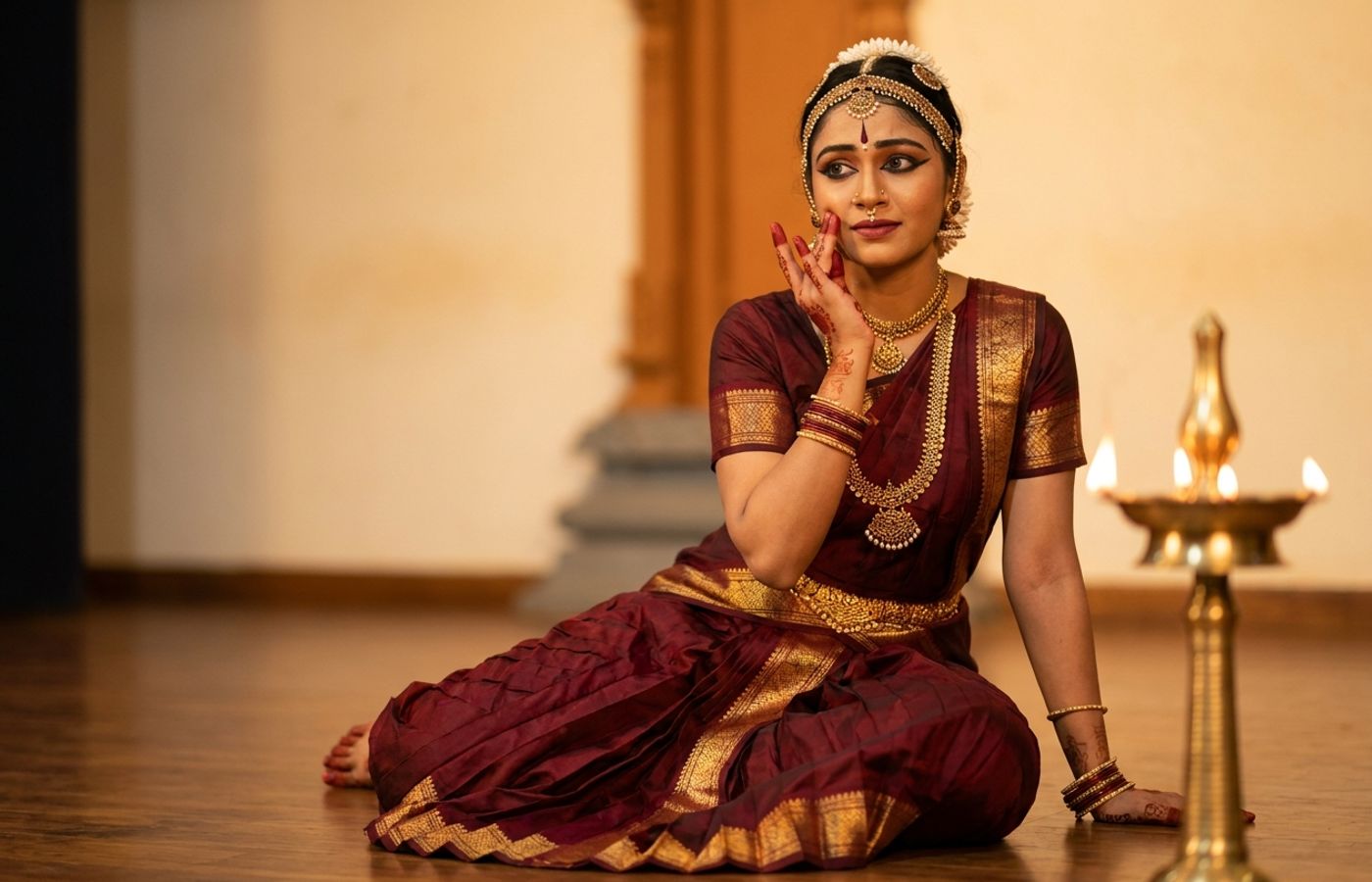
By the time a student is given her first Bharatanatyam padam, she has already spent years learning how to move. She can hold aramandi without shaking. She can land an adavu on the exact beat. She has carried a varnam from its opening line to its final jathi. The padam asks for something entirely different. It asks her to become still and to speak. The feet quieten, the tempo slows to a crawl, and the whole weight of the piece shifts to the face, the eyes, and the hands. For many dancers this is the moment when Bharatanatyam stops being a physical discipline and becomes an act of telling.
What a Padam Actually Is
A padam is a composition built for abhinaya. Where nritta is pure movement with no meaning attached to it, and nritya blends movement with expression, the padam sits almost wholly in the world of expression. The dancer is given a poem, usually short, set to a raga and a tala, and her task is to reveal everything inside that poem through gesture and feeling. The choreography does not exist to display technique. It exists to serve a line of text.
Structurally a padam follows the familiar shape of a Carnatic composition. There is a pallavi, the opening refrain that returns again and again. There is an anupallavi that extends the thought. There are one or more charanams that carry the poem forward. What makes the padam distinctive is not this structure but what the dancer does inside it. A single line of the pallavi may be repeated six or eight times, and each repetition must carry a different shade of the same emotion. The words do not change. The interpretation does.
This is why gurus place the padam late in a student's training. A dancer who has not yet internalised her hastas, her bhedas, and a clean aramandi will fill the silences of a padam with fidgeting. A dancer who has done that work can stand almost motionless and still hold a room.
Where the Padam Sits in the Margam
The traditional margam is arranged as a deliberate arc. It opens with alarippu, a pure nritta invocation that awakens the body. Jathiswaram follows, adding melodic and rhythmic complexity while remaining pure movement. Shabdam introduces the first real narrative content. The varnam then arrives as the long central pillar of the recital, alternating dense rhythmic passages with sustained expressive ones, and it is usually the most demanding item a dancer performs.
After the varnam, the recital changes temperature. This is where the padam appears. Having spent the varnam proving what her body can do, the dancer now sets that aside. The padam, and often a javali after it, occupies the expressive second half of the evening. The tillana then returns the audience to pure rhythm and brilliance before a closing shloka or mangalam. Placed this way, the padam is the quiet centre of the arc, the moment the audience leans in rather than sits back.
Why the Bharatanatyam Padam Moves So Slowly
A Bharatanatyam padam is typically set in vilamba kala, the slowest tempo, and students almost always find this harder than fast footwork. Speed hides things. Slowness exposes them. When a phrase stretches across many beats, there is nowhere for an unconvincing expression to hide, and there is no rhythmic excitement to carry the dancer along.
The slow tempo exists for a reason. It gives the dancer room to inhabit the sthayi bhava, the dominant emotional state of the piece, and then to open it out. It also matches how the poetry works. Padam texts are compressed. A single line may hold a memory, a reproach, and a hope all at once, and the tempo gives the dancer time to unpack that.
Abhinaya, Sanchari Bhava, and the Work of Elaboration
Classical theory divides abhinaya into four kinds, and all four are at work in a padam. Angika is expression through the body, the hastas and the bhedas of head, neck, and eyes. Vachika belongs to the sung text. Aharya covers costume, jewellery, and makeup, which help the audience read who the dancer is portraying. Sattvika is the internal dimension, the genuine feeling that makes an expression believable rather than performed.
The technique that turns a short poem into a full piece is sanchari bhava. When the pallavi returns, the dancer does not simply repeat what she did before. She builds a small episode around the line, a passing scene that illuminates it from a new angle. If the line speaks of waiting for Krishna, one repetition might show the woman remembering how he once came to her. Another might show her doubting whether he will come at all. Another might show her listening for footsteps that turn out to be nothing. The text stays fixed while the dancer travels around it.
Sanchari bhava is not free improvisation. It is disciplined imagination, guided by the guru, bounded by the poem, and grounded in accurate viniyoga, the correct application of each hasta. A student who invents without that grounding produces something that may look expressive but no longer says what the poet wrote.
The Nayika: Understanding Who Is Speaking
Most padams are spoken in the voice of a nayika, a heroine, addressing or speaking about a nayaka, a hero who is very often a deity. Krishna, Shiva, and Murugan appear constantly. The emotional register is usually shringara, but it is shringara understood as madhura bhakti, devotion expressed in the language of human love. Reading these poems as merely romantic misses their entire purpose.
Classical poetics describes eight types of nayika, the ashtanayika, and identifying which one the poem presents is the first analytical step in learning a padam. The vasakasajjika has prepared herself and waits in expectation. The virahotkanthita aches in separation. The svadhinabhartruka is secure in a lover who is devoted to her. The khandita is angry at a lover who has come to her after being elsewhere. The kalahantarita regrets a quarrel she caused. The vipralabdha has been disappointed at a meeting that never happened. The proshitabhartruka endures a long absence. The abhisarika goes out herself to meet him.
A dancer portraying a khandita nayika will hold her body differently and place her reproach differently than one portraying a virahotkanthita. When we teach a padam, this identification happens before a single step is set.
Padam and Javali Are Not the Same Thing
Students frequently confuse the two, and the distinction matters. The padam is slow, weighty, and inward. Its emotion tends toward the devotional even when the imagery is worldly. The javali, a later form, is faster, lighter, more colloquial, and more openly playful in its treatment of love. Where a padam invites contemplation, a javali invites a smile.
In performance the two complement each other. A javali placed after a padam lifts the mood and prepares the room for the brightness of the tillana. Learning to shift between the two registers, sometimes within minutes, is part of what makes an advanced dancer.
The Composers Whose Padams We Still Dance
The Telugu padam repertoire owes an enormous debt to Kshetrayya, the seventeenth century composer whose songs are addressed to Muvva Gopala, the form of Krishna that appears as his signature in the final lines. His padams are psychologically precise and remain among the most demanding abhinaya material a dancer can take on.
The Tamil repertoire draws heavily on composers such as Ghanam Krishna Iyer and Subbarama Iyer, whose padams remain staples of the recital stage. Swati Tirunal of Travancore contributed compositions in several languages that are still danced today. On the javali side, Dharmapuri Subbarayar and Pattabhiramayya are names a serious student will encounter. Knowing the composer tells the dancer something about the idiom, the language, and the emotional world she is entering.
How We Prepare a Student for Her First Padam
At Sridevi Dance Academy in Lexington, Kentucky, and in our online classes for diaspora families across the country, a padam is never simply handed to a student as choreography to memorise. The work begins with the text. We go through the poem line by line, word by word, establishing meaning before movement. Many of our students are learning in a language they do not speak at home, so this stage takes time and it is never skipped.
Next comes the nayika and the sthayi bhava. Who is speaking, to whom, and in what state. Only then do we set the hastas and the viniyoga for each phrase, checking that every gesture is doing real work rather than decorating the line. Sanchari passages come last, and they are built gradually, one repetition at a time, until the dancer can hold the whole arc without losing the thread. Along the way we return constantly to griva bheda, shiro bheda, and drishti bheda, because in a padam the neck, head, and eyes are carrying most of the message.
The Difficulties Every Dancer Meets Here
The first difficulty is the fear of stillness. Students trained to fill every beat with movement find silence unbearable and start to embellish. The correction is patience, and repetition in front of a mirror until stillness stops feeling like failure.
The second is generic expression. A face that means happy in general, or sad in general, reads as nothing in particular. The remedy is specificity. Not sadness, but the sadness of someone who has just heard a sound at the door and realised it was not him.
The third is emotional dishonesty. Young dancers sometimes perform a feeling they do not understand, and audiences sense it immediately. The guru's task is to find a bridge, some experience in the student's own life that gives her honest access to the poem. This is slow, individual work, and it is one reason we keep our classes small.
What the Padam Gives Back
Dancers who work seriously on padams find that their entire practice changes. The varnam becomes deeper because its expressive passages are no longer just rest between jathis. Even nritta items gain something, because a dancer who has learned to communicate does not switch that ability off when the footwork begins.
There is a further reward that has nothing to do with the stage. To learn a padam properly is to sit with a poem that is centuries old, understand what it says, and find that it still describes something recognisably human. For a student growing up far from where these songs were written, that connection is worth as much as any technical achievement. It is one of the clearest reasons we teach the theory and the meaning alongside the movement, so that our students understand the form rather than only perform it. If your child has moved past the foundational adavus, or you are an adult returning to Bharatanatyam and drawn to its expressive side, we are glad to talk it through with you.
Common questions
What is a padam in Bharatanatyam?
A padam is a slow, expressive composition in the Bharatanatyam repertoire in which abhinaya, or expression, carries the piece rather than footwork. The dancer interprets a short poem set to a raga and tala, repeating its lines and revealing a new shade of meaning with each repetition through gesture, facial expression, and eye movement.
Where does the padam come in a Bharatanatyam margam?
The padam is performed after the varnam, in the expressive second half of the recital. The margam typically moves from alarippu and jathiswaram through shabdam to the varnam, then into padams and javalis, and closes with a tillana and a mangalam or shloka. Placing the padam after the varnam lets the recital shift from physical display to inward storytelling.
What is the difference between a padam and a javali?
A padam is slower, weightier, and more contemplative, and its love imagery usually carries a devotional meaning. A javali is faster, lighter, more colloquial, and more openly playful in its treatment of love. Javalis are a later form and are often performed after a padam to lift the mood before the tillana.
At what stage should a student begin learning padams?
Padams are advanced material. A student should have secure adavus, a stable aramandi, accurate hastas, and control of griva, shiro, and drishti bhedas before starting. Most dancers approach their first padam only after working on a varnam, because the padam offers no rhythmic excitement to hide behind and depends entirely on expressive control.
Do I need to know Telugu or Tamil to perform a padam?
You do not need to speak the language, but you do need to understand the text thoroughly. We work through the poem word by word with every student so that each gesture is anchored in actual meaning. Dancing a padam without knowing what the words say produces movement that looks expressive but communicates nothing specific.
What is sanchari bhava and why does it matter in a padam?
Sanchari bhava is the elaboration a dancer builds when a line of text repeats. Rather than repeating the same interpretation, she creates a short episode that illuminates the line from a new angle. It is what turns a poem of a few lines into a piece lasting many minutes, and it is guided by the guru and bounded by the meaning of the text rather than improvised freely.