intermediate
Bharatanatyam Neck Movements: A Guide to Griva Bheda
Griva bheda, the four Bharatanatyam neck movements, explained by a guru: Sundari, Tirashchina, Parivartita, and Prakampita, with meaning and practice tips.
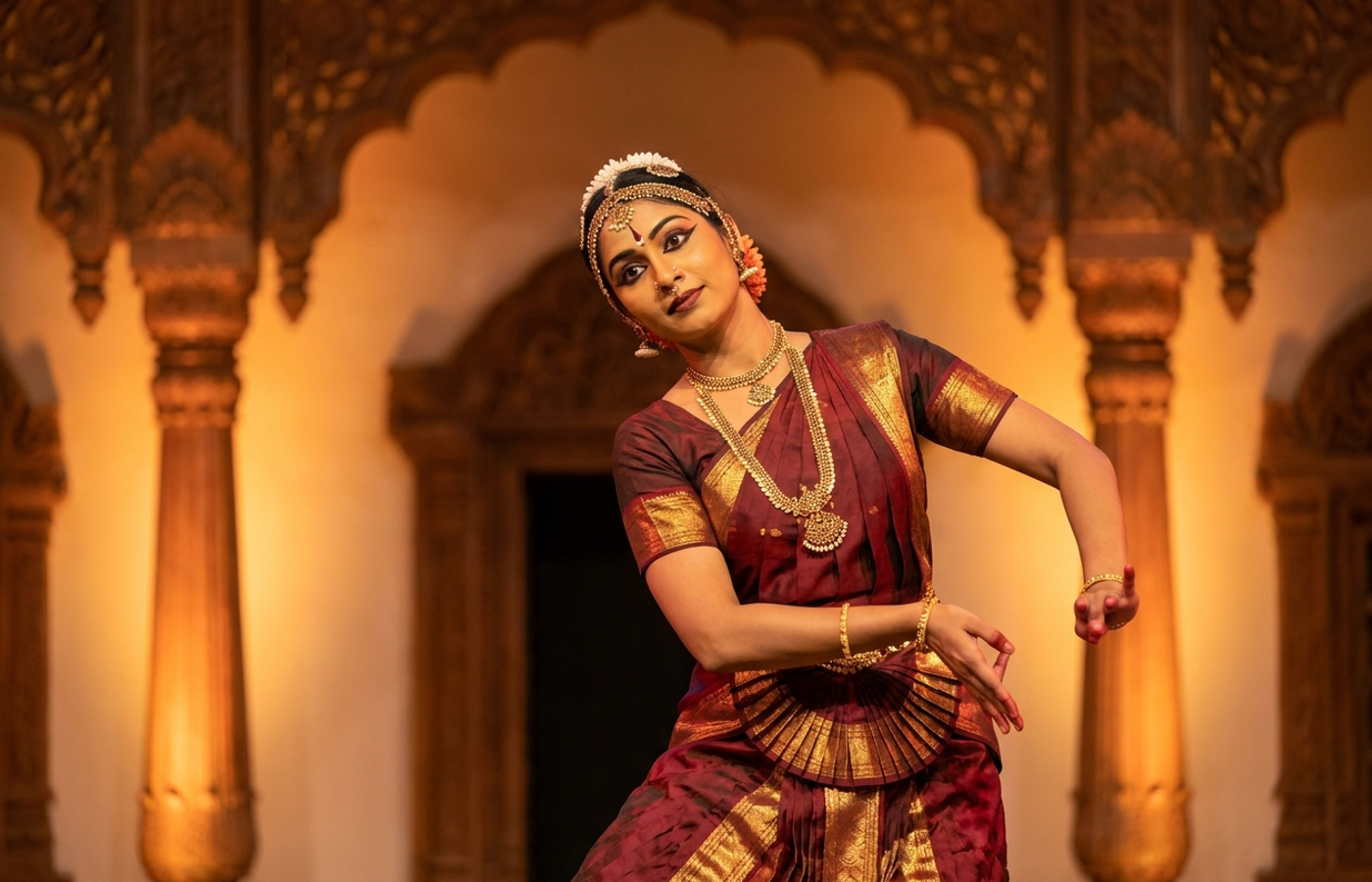
In Bharatanatyam, the smallest movements often carry the most meaning. Griva bheda, the classical study of neck movements, is one of them. Griva means neck and bheda means division or type, so griva bheda simply names the ways the neck is trained to move. Along with shiro bheda for the head and drishti bheda for the eyes, it forms the trio of anga bhedas that a student learns together. A dancer can hold every hasta correctly and still look lifeless if the neck is asleep. Learn griva bheda well, and a gesture stops being merely correct and starts to speak.
What Griva Bheda Means in Bharatanatyam
The word bheda points to classification. The classical texts do not leave the body to move by instinct; they name and count each movement so it can be taught, corrected, and passed down through the guru-shishya parampara. Griva bheda is the section of that grammar devoted to the neck. The Abhinaya Darpanam, one of the foundational manuals of the form, enumerates four neck movements and gives each a name, a shape, and a set of feelings it can express. When we teach griva bheda, we are teaching a vocabulary, not a set of tricks. Every movement has a purpose in abhinaya, the expressive storytelling that sits at the heart of Bharatanatyam.
The Neck Moves Alone
The first lesson of the neck movements is isolation. The neck works while the shoulders, chest, and spine stay quiet and level. If the shoulders travel with the neck, the movement is lost and the line of the body collapses. Beginners often recruit the whole upper body to turn the head, which reads as effort rather than grace. In class we ask students to rest their hands on their shoulders at first, so they can feel the shoulders staying put while the neck slides, arcs, or trembles on its own. Isolation is difficult precisely because it is subtle, and it is the difference between a neck that looks alive and one that looks stiff.
The Four Griva Bhedas
The Abhinaya Darpanam names them in a single verse: Sundari, Tirashchina, Parivartita, and Prakampita. We recite them in this order in class because it is the order of the enumeration sloka, and memorizing the sequence is the first step to owning the movements.
Sundari, meaning beautiful and also called attami, moves the neck from side to side in a level, sliding motion. The head stays upright, the face points to the front, and the chin neither lifts nor dips. Of the four, this is the one most associated with charm. It expresses shringaram, the mood of love, beauty, and delight, and it is the movement that ornaments a jathi and gives abhinaya its glow.
Tirashchina, meaning oblique or crosswise, traces a V shape with the neck. The movement travels down and across to one side, then up and across to the other, the two strokes meeting at a point below. It is used to show searching, the act of looking about for something or someone, and it can also suggest the gliding of a snake.
Parivartita, meaning turned around, carries the neck in a smooth semi-circle, an arc like the crescent moon, moving from one shoulder round to the other and back again. It expresses childish anger and sulking, the coy turning away of a beloved, and, like tirashchina, the act of searching. It is a favorite in playful and romantic passages of storytelling.
Prakampita, meaning trembling or shaken, moves the neck forward and back along a straight line with the chin held level throughout. The head travels out and draws in without rising or falling. It mimics the movements of a bird, the pigeon's walk or the strut of a peacock, and it can also stand for conversation or for beckoning someone near.
How Griva Bheda Brings Abhinaya to Life
A neck movement rarely travels by itself. One learned clean and alone is only the starting point; the art appears when the eyes and the face join it. The neck is the hinge between the hand and the heart. Where the hand goes the eyes follow, and it is the griva that carries the eyes there. This is why we teach the three anga bhedas together. A dancer telling the story of a woman searching for her beloved might cast the neck about with tirashchina, let the drishti bheda send the eyes ahead, and finish the sentence with the face. Alone, each movement is a shape. Together, they are speech.
Common Mistakes to Watch For
A few errors show up again and again, and naming them helps students correct themselves at home. The most common is letting the shoulders rise or drift with the neck, which turns a light movement into a heavy one. Another is leading with the chin or the jaw instead of the neck, so the head tilts up or down when the bheda asks for a level line. Many beginners also rush, chasing speed before the shape is clean, which blurs one movement into the next. Finally, students often treat the four as empty exercises and forget the bhava, performing a technically accurate Sundari that shows no delight at all. Slow, named, and expressive practice fixes all four.
How We Teach the Neck Movements at Sridevi Dance Academy
At Sridevi Dance Academy in Lexington, Kentucky, and in our online classes for diaspora families, griva bheda is taught the way it has always been taught: slowly, by name, and with the meaning attached. Students first work each movement to a count, then to a jathi, keeping the chin level unless the bheda asks otherwise. Only when the shapes are clean do we add the eyes and the bhava. Our founder, a Bharatanatyam guru who also brings the precision of a career in pharmaceutical microbiology, insists that students understand what a movement shows before they perform it. A neck that knows it is expressing shringaram moves differently from one that is only copying a shape.
Practicing Griva Bheda Safely
Because these movements isolate a delicate part of the body, they should be practiced with care. Sit or stand tall with the shoulders pressed down and still. Recite the four names aloud and work each movement without forcing the range, letting the motion come from the neck alone rather than from the jaw or the shoulders. Warm up gently, never push into pain, and build speed only after the shapes are secure. This measured approach, safe progression under a guru's eye, is central to how we train at the academy, and it is one reason we keep classes small and disciplined.
Where Griva Bheda Fits in Your Journey
The neck movements belong to the foundation years of Bharatanatyam, learned alongside the adavus and the other anga bhedas before a student takes on longer items of the margam. This is not a topic a dancer finishes and leaves behind. The same four movements that a beginner practices to a count return, refined and expressive, in a varnam or a padam years later. If you are considering classical dance for your child or returning to the art as an adult, learning to move the neck with intention is one of the earliest signs that real training has begun.
Whether you join us in Lexington or online from anywhere in the diaspora, the study of griva bheda is where a gesture learns to breathe. To see how these foundations fit into a full course of study, explore our classes or schedule a trial, and bring your questions to a guru who will name every movement for you.
Common questions
What is griva bheda in Bharatanatyam?
Griva bheda is the classical study of neck movements in Bharatanatyam. Griva means neck and bheda means type or division. It is one of the three anga bhedas, taught alongside shiro bheda for the head and drishti bheda for the eyes, and it gives abhinaya much of its life and expression.
How many griva bhedas are there and what are their names?
The Abhinaya Darpanam counts four: Sundari, Tirashchina, Parivartita, and Prakampita. Sundari slides the neck side to side, Tirashchina traces a V shape, Parivartita moves in a semi-circle like the crescent moon, and Prakampita moves forward and back with the chin level.
What is the difference between shiro bheda, drishti bheda, and griva bheda?
They are the three anga bhedas, or minor-limb studies. Shiro bheda is the movements of the head, drishti bheda is the movements of the eyes, and griva bheda is the movements of the neck. Students learn all three together because in performance the head, eyes, and neck usually move as one.
Why is neck isolation so important in these movements?
The neck must move while the shoulders, chest, and spine stay still and level. If the shoulders follow the neck, the movement is lost and the body looks stiff. Clean isolation is what makes a griva bheda read as graceful from the back row rather than as effort.
At what stage do students learn griva bheda?
Griva bheda is part of the foundation years, learned with the adavus and the other anga bhedas before a student takes on longer margam items. The same movements return in more expressive form in advanced pieces such as varnams and padams, so it is a lifelong part of training rather than a one-time lesson.
Can I learn griva bheda online?
Yes. Sridevi Dance Academy teaches in person in Lexington, Kentucky and online for diaspora families. Neck movements can be taught well over video when a guru watches closely, corrects isolation, and connects each movement to its meaning and bhava, which is exactly how we structure our online classes.