intermediate
Bharatanatyam Mudras: A Guru's Guide to Hastas and Their Meaning
Learn Bharatanatyam mudras the traditional way: asamyuta and samyuta hastas, their viniyogas, and how a guru builds precise, expressive hands, step by step.
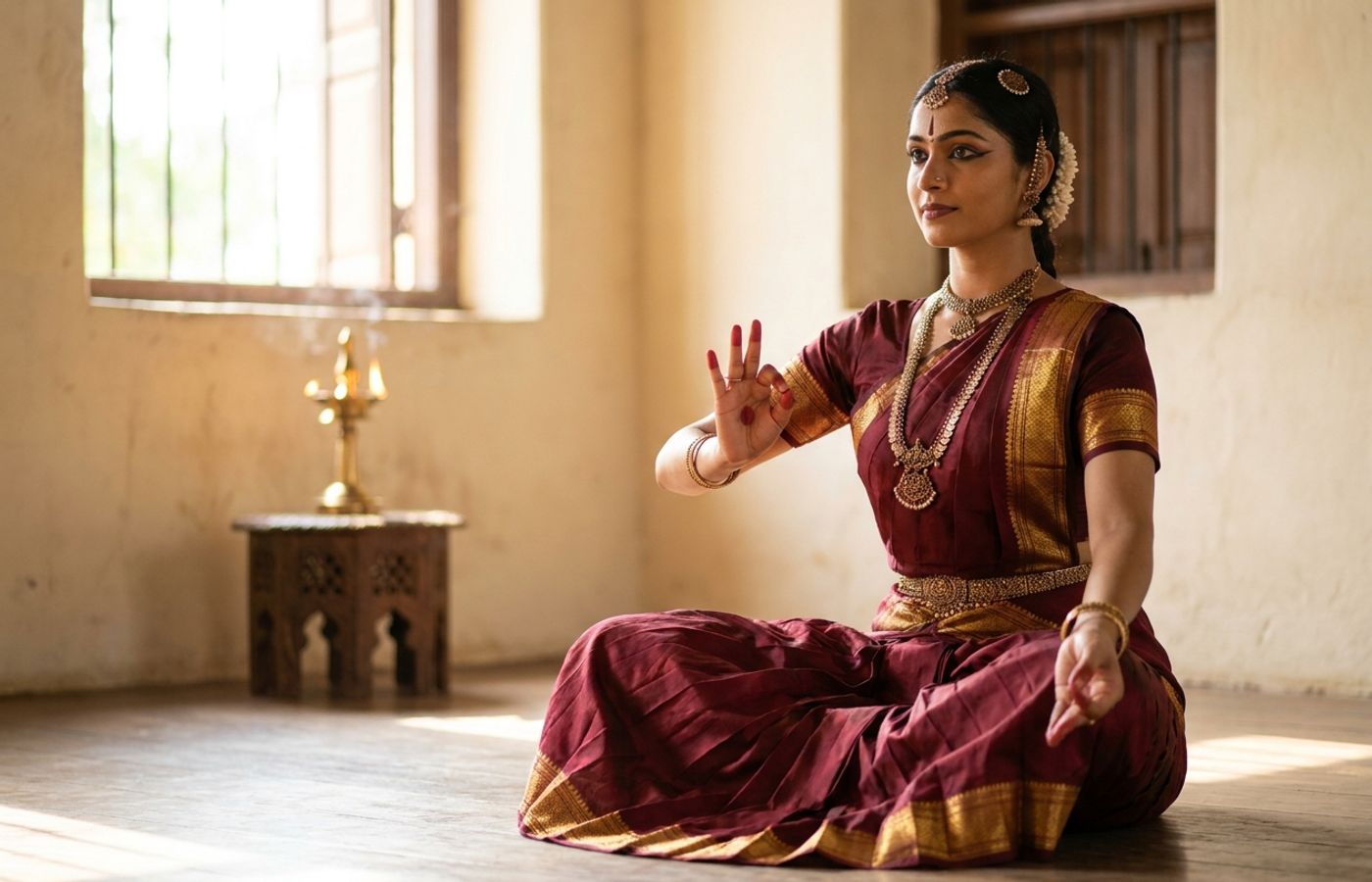
Watch a Bharatanatyam dancer for even a minute and your eyes will go to the hands. Bharatanatyam mudras, the codified hand gestures of the art, are what allow a dancer to become a storyteller: a single turn of the wrist can summon a deer, a lamp, a river, or a god. In the classical treatises these gestures are properly called hastas, and they are not decorative. Each one has a defined shape, a family of meanings, and a correct way of being held, carried, and released. This guide explains what the mudras of Bharatanatyam are, how the tradition organizes them, and how a serious student actually learns them, whether in our Lexington, Kentucky studio or in our online classes for diaspora families across the United States.
What Are Bharatanatyam Mudras?
The word mudra comes from Sanskrit and is commonly translated as seal, sign, or gesture. In the dance treatises themselves, particularly the Abhinaya Darpana of Nandikeshvara, the term used is hasta, which simply means hand. In practice the two words are used interchangeably by dancers today: mudra is the popular term, hasta is the textual one. At Sridevi Dance Academy we teach students both names from the beginning, because a student who knows the vocabulary of the shastra reads the tradition, not just the steps.
Hastas serve two distinct purposes in Bharatanatyam. In nritta, the pure dance sections built on rhythm and geometry, the hands complete the line of the body. They frame the aramandi, extend the reach of the arm, and give each adavu its finished form. Here the gesture carries no story; it carries design. In nritya and abhinaya, the expressive dimensions of the art, the same hands become language. Combined with facial expression, or bhava, and the movements of the neck, head, and eyes described in the griva, shiro, and drishti bhedas, hastas name characters, objects, actions, and emotions. One vocabulary, two jobs. Understanding this distinction early prevents a common beginner habit: performing every gesture as if it must mean something, when often it must simply be clean.
Asamyuta Hastas: The Twenty Eight Single Hand Gestures
The Abhinaya Darpana lists twenty eight asamyuta hastas, gestures formed with one hand. The sequence begins with Pataka, the flag, in which the palm is held flat with all fingers extended and the thumb bent to touch the base of the index finger. From Pataka the list unfolds through Tripataka, Ardhapataka, Kartarimukha, Mayura, Ardhachandra, Arala, Shukatunda, Mushti, Shikhara, Kapittha, Katakamukha, Suchi, Chandrakala, Padmakosha, Sarpashirsha, Mrigashirsha, Simhamukha, Kangula, Alapadma, Chatura, Bhramara, Hamsasya, Hamsapaksha, Sandamsha, Mukula, Tamrachuda, and Trishula.
Students memorize this sequence as a shloka, a verse recited aloud while forming each shape in order. The recitation is not a formality. Saying the names while making the shapes binds language, memory, and muscle together, which is exactly how the guru-shishya parampara has transmitted this material for generations. In class we drill the sequence slowly, checking each hasta against its definition: is the thumb truly at the base of the index finger in Pataka, or drifting? Are the fingers of Alapadma opening one by one like a full blown lotus, or collapsing together? Precision here is not fussiness. Every mudra downstream of these basics inherits either the clarity or the sloppiness of the foundation.
Samyuta Hastas: The Twenty Three Double Hand Gestures
When both hands join to form a single gesture, the result is a samyuta hasta. The Abhinaya Darpana describes twenty three of them, beginning with Anjali, the familiar gesture of salutation in which both palms press together. The list continues through Kapota, Karkata, Swastika, Dola, Pushpaputa, Utsanga, Shivalinga, Katakavardhana, Kartariswastika, Shakata, Shankha, Chakra, Samputa, Pasha, Kilaka, Matsya, Kurma, Varaha, Garuda, Nagabandha, Khatva, and Bherunda.
Many samyuta hastas are built from asamyuta components, which is why the single hand gestures are always taught first. Matsya, the fish, is formed from two Ardhapataka hands layered with thumbs extended like fins. Garuda, the divine eagle, crosses two Ardhachandra hands at the wrists. Shankha and Chakra, the conch and discus held by Lord Vishnu, appear constantly in items describing the deity, and a dancer who forms them vaguely blurs the very iconography the audience is meant to recognize. The double hand gestures reward patience: they demand that both hands hold their shapes independently while cooperating in one image.
Viniyoga: One Gesture, Many Meanings
A common misunderstanding is that each mudra has one meaning, as if the vocabulary were a simple dictionary. The tradition is richer than that. Each hasta carries a list of viniyogas, or applications, recorded in verse. Pataka alone can indicate the beginning of a dance, clouds, a forest, denial, a river, a horse, cutting, wind, and more. Katakamukha can hold a garland, pluck flowers, or draw a bowstring. Which meaning applies depends entirely on context: the sahitya being sung, the character being portrayed, the accompanying bhava on the face, and the placement of the gesture in space.
This is why mudras cannot be learned from a chart alone. A chart shows the shape; it cannot show the usage. In our classes, students first learn the shapes and names, then the viniyoga shlokas, and finally the application inside actual choreography, from the first alarippu to jathiswaram, varnam, and the full margam. When a student sees Alapadma become a lotus in one line of a padam and a question in another, the vocabulary stops being abstract and becomes expressive language. Theory and application travel together, which is how the art form was designed to be taught.
How We Teach Mudras at Sridevi Dance Academy
At Sridevi Dance Academy in Lexington, Kentucky, and in our online batches for students across the diaspora, mudras enter the curriculum in the very first term, alongside aramandi and the first adavus. Our founder, Sridevi Thyagarajan, began her own training at age four within the guru-shishya parampara, and she brings a scientist's discipline to the studio: every hasta is measured, named, and understood before it is performed. Students recite the shlokas, form each gesture, and are corrected individually, because a mudra that is almost right is still wrong.
We also teach the anatomy of comfort. Young dancers often over-grip, turning Mushti into a clenched fist that stiffens the whole arm, or hyperextending fingers in Pataka until the hand trembles. The correction is always the same principle: firm shape, quiet effort. The fingers hold their positions with the minimum tension required, the wrist stays supple, and the energy of the gesture travels outward through the fingertips rather than locking in the knuckles. Practiced this way, mudras strengthen the hands safely and remain sustainable through a two hour margam.
Practicing Mudras at Home
Between classes, short and regular practice beats long and occasional practice. Ten focused minutes a day is enough for a beginner. Recite the asamyuta hasta shloka while forming each gesture with both hands in front of a mirror. Check three things for every shape: the thumb placement, the spacing of the fingers, and the angle of the wrist. Then pick any three hastas and recall two viniyogas for each, saying them aloud. Parents of young students can help without knowing any dance at all: ask your child to show you a gesture and tell you what it can mean. Explaining a mudra out loud is one of the fastest ways to fix it in memory.
As students advance, home practice grows with them: forming hastas while moving through adavus, keeping the shapes steady at speed, and rehearsing the gesture passages of current repertoire in tala. By the time a dancer approaches arangetram preparation, the mudras are no longer something she thinks about. They are simply how her hands speak.
Mudras are the vocabulary of Bharatanatyam, and like any language they are best learned from a fluent teacher, in order, with patience. If you are in Lexington, Kentucky, or anywhere online, we would be glad to introduce you or your child to this vocabulary the traditional way: one guru, one lineage, and a curriculum that explains the meaning behind every movement. Schedule a trial class and watch the hands begin to speak.
Common questions
How many mudras are there in Bharatanatyam?
Following the Abhinaya Darpana, Bharatanatyam training uses twenty eight asamyuta hastas, formed with one hand, and twenty three samyuta hastas, formed with both hands together. Other texts such as the Natya Shastra give somewhat different lists, which is why counts vary between sources. Most teaching lineages, including ours, follow the Abhinaya Darpana sequence.
What is the difference between a mudra and a hasta?
In practice they refer to the same thing. Hasta, meaning hand, is the term used in the classical dance treatises, while mudra is the more popular word today. Dancers and teachers use both interchangeably, and students benefit from knowing the textual term as well as the common one.
Which mudra should a beginner learn first?
Pataka, the flag, is the first gesture in the traditional sequence and the foundation for many others. Beginners learn the full asamyuta hasta sequence in order, recited as a shloka, before moving to the double hand gestures, since many samyuta hastas are built from single hand components.
Do Bharatanatyam mudras have fixed meanings?
No. Each hasta has a list of viniyogas, or applications, recorded in verse. Pataka can indicate clouds, a forest, a river, or denial, among other things. The intended meaning comes from context: the lyrics being interpreted, the character portrayed, the dancer's expression, and where the gesture is placed in space.
Are mudras used even when the dance is not telling a story?
Yes. In nritta, the pure dance sections, hastas complete the geometry of the movement without carrying narrative meaning. The same vocabulary becomes storytelling language in abhinaya. Students learn both uses, and learning to hold a gesture cleanly in nritta is what makes it expressive later in abhinaya.
Can children learn Bharatanatyam mudras online?
Yes, with a structured approach. In our online classes, students form each hasta on camera and receive individual corrections, recite the traditional shlokas, and follow the same multi-year curriculum as our in-person students in Lexington, Kentucky. Regular short practice at home between classes is the key to steady progress.