intermediate
Bharatanatyam Alarippu: The Margam's Opening Flower
Bharatanatyam alarippu is the margam's opening item: pure nritta that wakes the body part by part. Its meaning, structure, talas, and how we teach it.
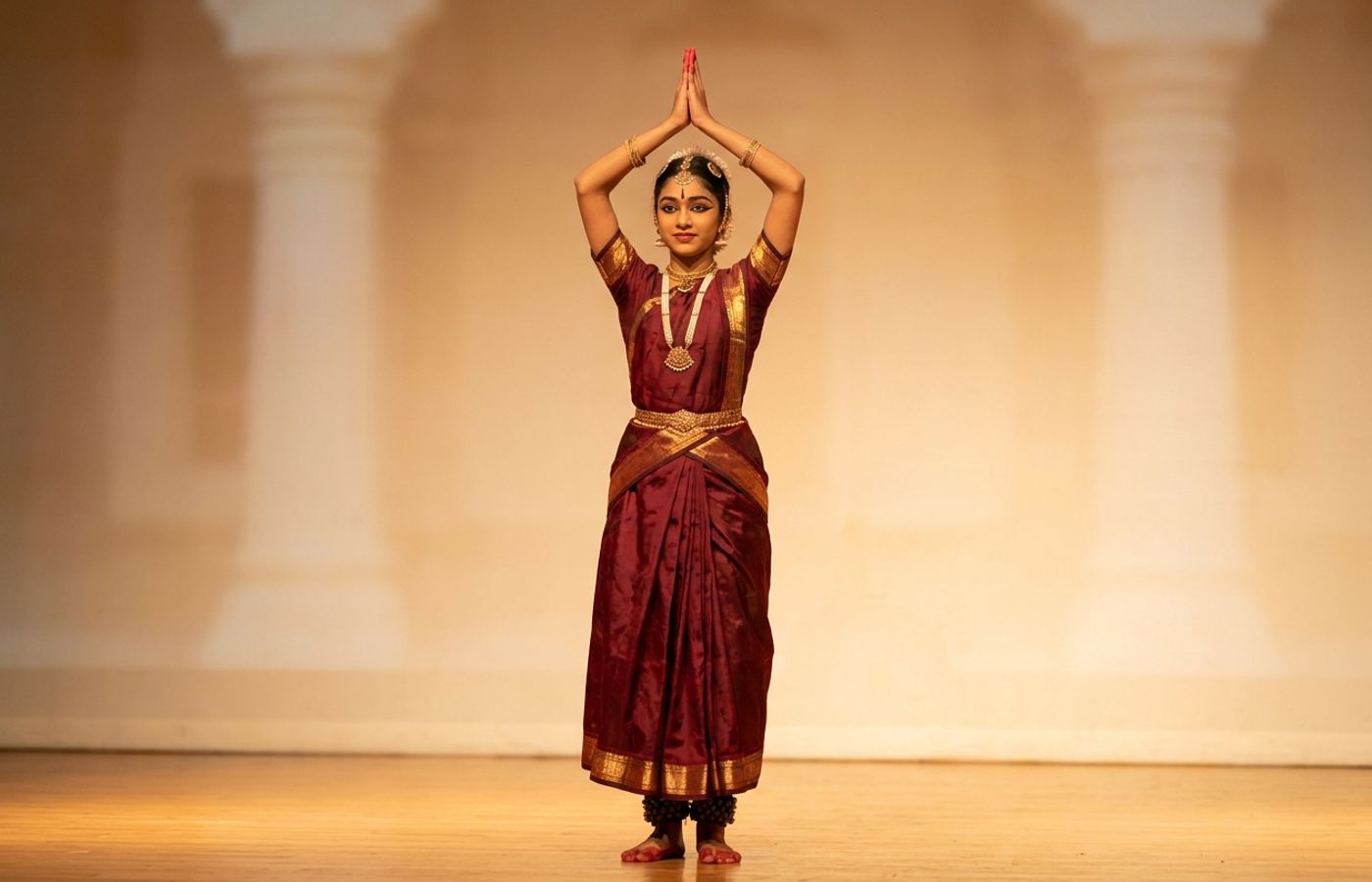
Bharatanatyam alarippu is the first item almost every dancer meets, and the one they return to for the rest of their dancing life. It is short. It tells no story. It is often mistaken for a warm up. In a serious classroom it is none of those things. Alarippu is where a student learns that a body can be tuned the way an instrument is tuned, one part at a time, before a single line of poetry is ever danced.
In our classes we do not hand a student alarippu because a season is starting or a recital is near. We teach it when the aramandi holds without collapsing, when tatta adavu lands on the beat rather than near it, and when the eyes can move without the head following. Until then, alarippu would only rehearse bad habits at performance speed. When those foundations are in place, the piece becomes what it was designed to be: an invocation, a diagnostic, and a discipline.
What the Word Alarippu Means
The name is usually traced to a word for blossoming, or for adorning with flowers. The image is precise rather than decorative. The dancer begins folded and almost motionless, palms joined above the head in anjali hasta, and opens outward in measured stages until the whole body is awake and available. A bud does not open all at once. Neither does alarippu.
Structurally it is pure nritta. There is no sahitya, no lyric, and therefore no abhinaya in the usual sense. The piece is set to rhythmic syllables, the solkattu recited by the nattuvanar and answered by the mridangam. Because there is no melodic composition carrying the dancer, alarippu is danced on rhythm alone. Nothing covers a late landing or a soft knee. This is exactly why it is placed first and why gurus keep returning to it.
Why the Margam Opens with Alarippu
The margam, the traditional concert sequence of Bharatanatyam, was codified in the nineteenth century by the Thanjavur Quartet, the four brothers Chinnayya, Ponnayya, Sivanandam and Vadivelu. Their ordering moves a recital from pure rhythm through increasing expressive weight, and alarippu stands at the doorway.
It functions as an invocation in three directions at once. The dancer offers salutation to the divine, to the guru and the musicians, and to the audience who has come to watch. It also does honest physical work. The breath settles, the joints open, the tala is stated plainly so that listeners can hear the rhythmic cycle the rest of the recital will build on. A dancer who skips this preparation arrives at jathiswaram and varnam with a body that is still negotiating with itself.
How a Bharatanatyam Alarippu Unfolds
The choreography travels through the body in a deliberate order, from the smallest movements to the largest. It usually begins with the eyes, then the neck. The drishti bhedas and the griva bhedas, especially the side to side attami, appear here in their clearest form. Then the shoulders release, the arms extend and draw back, the torso begins to participate, and only after that does the piece descend into the legs.
The lower half brings the dancer into aramandi, the half sitting position that defines the form, and often into muzhumandi, the full sit, in the later passages. Movements grow wider, the arms cut cleaner lines, and the piece closes with a teermanam, a rhythmic full stop that resolves the cycle. Watched from the audience, alarippu looks like a body assembling itself in public. That is a fair description of what it is.
Tala and Gathi: Why There Is More Than One Alarippu
Students are sometimes surprised to learn that alarippu is not a single fixed composition. It is a form that is recast in different rhythmic frameworks. The same architectural idea appears in tisra, chatusra, khanda, misra and sankeerna, each grouping the beats differently. A tisra alarippu counts in threes. A misra alarippu counts in sevens and feels considerably longer in the body even when the choreography is related.
Most beginners learn a tisra alarippu first, because groups of three are the easiest place to feel a cycle land. Later, giving a student the same piece in a different gathi is one of the most useful teaching tools we have. The dancer already knows the shapes, so nowhere is left to hide except the rhythm itself. Learning the second alarippu is usually where a student truly starts to hear tala rather than count it.
The Adavus Hidden Inside the Piece
Alarippu is built from adavus the student already owns. Tatta adavu supplies the grounded beats. Natta adavu extends the leg and the reach. The mandi adavus, danced from the full sit, typically appear in the later section, which is where a weak aramandi finally announces itself. The korvai and teermanam sequences at the close draw those units into a single phrase.
This is why we treat alarippu as a diagnostic. When a student dances it, we are not only watching the piece. We are reading the quality of every adavu they have learned so far, under the pressure of continuous performance. Nothing exposes an unfinished foundation faster, and nothing is more useful for planning the next term of training.
What Makes Alarippu Genuinely Difficult
New students expect the difficulty to be in the steps. It is not. It is in stillness, symmetry and stamina. The most common problems we correct are a knee that lifts out of aramandi as the piece progresses, arms that drift out of their line when attention moves to the feet, eyes that go blank because there is no story to carry them, and a general drift ahead of the beat when nerves take over.
The remedy is never speed. It is repetition at a tempo the dancer can hold with full control, with the guru counting aloud, then with the syllables, then with the mridangam. Because there is no lyric to lean on, the piece is unforgiving, and because it is unforgiving, it teaches faster than almost anything else in the early curriculum.
How We Teach Alarippu in Lexington and Online
At Sridevi Dance Academy we teach in person in Lexington, Kentucky and online for diaspora families across the United States, and alarippu is taught the same way in both settings. Classes stay small so that corrections are individual rather than general. Training follows guru shishya parampara, which in practice means the same teacher watches the same student build over years and knows exactly which correction that student needs next.
For online students, we ask for a camera angle that shows the full body and the floor, because aramandi and the mandi passages cannot be judged from the waist up. Families are asked to keep a clear practice space with a hard, non slip surface. Progression is deliberate and safe, especially in the full sit, where young knees need conditioning before repetition. Parents are welcome to watch, and we would rather explain the reasoning behind a correction than have it look arbitrary at home.
A Piece You Never Finish Learning
Alarippu opens an arangetram, and it also opens the practice of dancers who have been performing for decades. The choreography does not change. What changes is the dancer: the line becomes cleaner, the stillness becomes deliberate rather than nervous, the eyes lead instead of follow, and the teermanam lands with the tala rather than beside it.
That is why we resist treating it as a beginner item to be cleared and forgotten. In this tradition the first thing you learn is also the last thing you master. If you are considering serious Bharatanatyam training for your child or for yourself, alarippu is a good place to understand what the training actually asks for, and we are glad to walk you through the full curriculum before you commit.
Common questions
What does alarippu mean in Bharatanatyam?
The name is traced to a word for blossoming, or for adorning with flowers. It describes the structure of the piece: the dancer begins almost motionless with palms joined above the head and opens outward in stages, moving from the eyes and neck to the arms, torso and legs, until the whole body is awake.
Is alarippu always the first item in the margam?
In the traditional margam codified by the Thanjavur Quartet, alarippu is the opening item. Many contemporary recitals place a pushpanjali or an invocatory verse before it, but alarippu remains the first item of the classical sequence and the first full composition most students learn.
Does alarippu have a raga?
Traditionally no. Alarippu is pure nritta set to rhythmic syllables recited by the nattuvanar and supported by the mridangam, rather than to a melodic composition with lyrics. That absence of melody and story is deliberate, since it leaves the dancer accountable to the tala alone.
How long does it take a student to learn alarippu?
It depends entirely on the student and how often they practise, so no honest teacher will promise a timeline. What we can say is what has to be in place first: a stable aramandi, clean tatta and natta adavus, and the ability to hold the rhythm without rushing. We introduce alarippu when those are secure, not on a fixed schedule.
What is the difference between pushpanjali and alarippu?
Pushpanjali is an offering of flowers, usually a short invocatory piece that may be set to a raga and can include salutation gestures. Alarippu is pure nritta with no melodic composition and no narrative content, structured around waking the body part by part. Many recitals include both, with pushpanjali first.
Can alarippu be learned properly in online classes?
Yes, when the class is small and the setup is right. We ask online students for a full body camera view that includes the floor, a clear and non slip practice surface, and consistent attendance so corrections carry from week to week. Our diaspora students learn the same alarippu, to the same standard, as our students in Lexington.